Serving St. Louis & Surrounding Areas

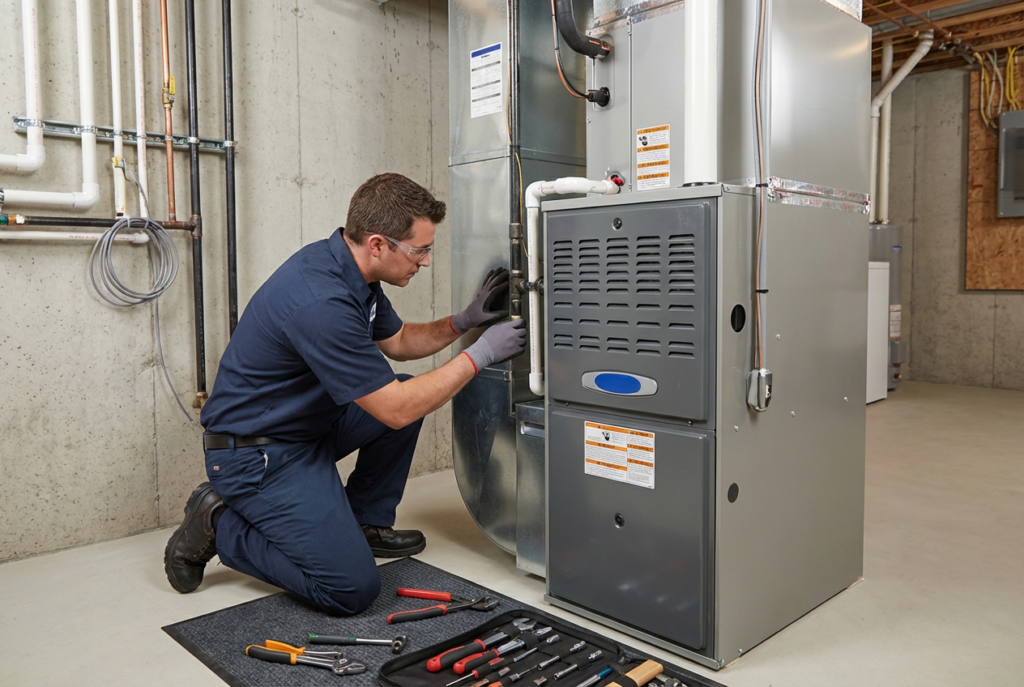
Need a New Furnace? Get New Furnace Installation Services in Oakville
Your furnace is 20 years old and barely keeps the house warm anymore. Every winter you wonder if this is the year it finally dies. Gas bills keep climbing because old furnaces waste tons of energy. Repair guy says it needs another $800 fix but recommends replacement instead. New furnace installation services in Oakville handle the whole process—figuring out what size you need, removing the old one, installing the new system correctly. Getting it sized wrong or installed poorly wastes thousands of dollars.
Types of Furnace Installation We Offer
Looking for a specific type of furnace? We install all major furnace types:
High-Efficiency Furnace Installation – 95-98% AFUE rating furnaces that save money on heating bills and qualify for energy rebates.
Standard Efficiency Furnace Installation – 80% AFUE furnaces that cost less upfront and work great for most homes.
Electric Furnace Installation – Electric heating systems for homes without gas service or where electric makes more sense.
Not sure which type fits your situation? Keep reading—we’ll help you figure out what makes sense for your house and budget.
Your Furnace Installation Guide
How to Know When You Need a New Furnace
Age is the biggest factor. Furnaces last 15-20 years with good maintenance. Once yours hits 15 years, start planning replacement even if it’s still working. Parts become harder to find. Efficiency drops as components wear out. You’re burning more gas for less heat. Waiting until complete failure in January means making rushed decisions when you’re freezing and desperate.
Repair costs adding up signal replacement time. One $400 repair on a 10-year-old furnace? Fix it. Three $500 repairs in two years on an 18-year-old furnace? You’re throwing money at equipment that’s dying. At some point you’re better off putting that repair money toward a new furnace that won’t need constant fixes.
Your house never feels comfortable anymore. Some rooms too hot, others freezing. Furnace runs constantly but temperature keeps dropping. These aren’t always fixable problems—sometimes your furnace is just worn out and can’t distribute heat properly anymore. Yellow pilot light instead of blue means incomplete combustion. Rust or cracks in the heat exchanger mean dangerous carbon monoxide risks. These are replacement situations, not repair situations.
Choosing the Right Size Furnace for Your House
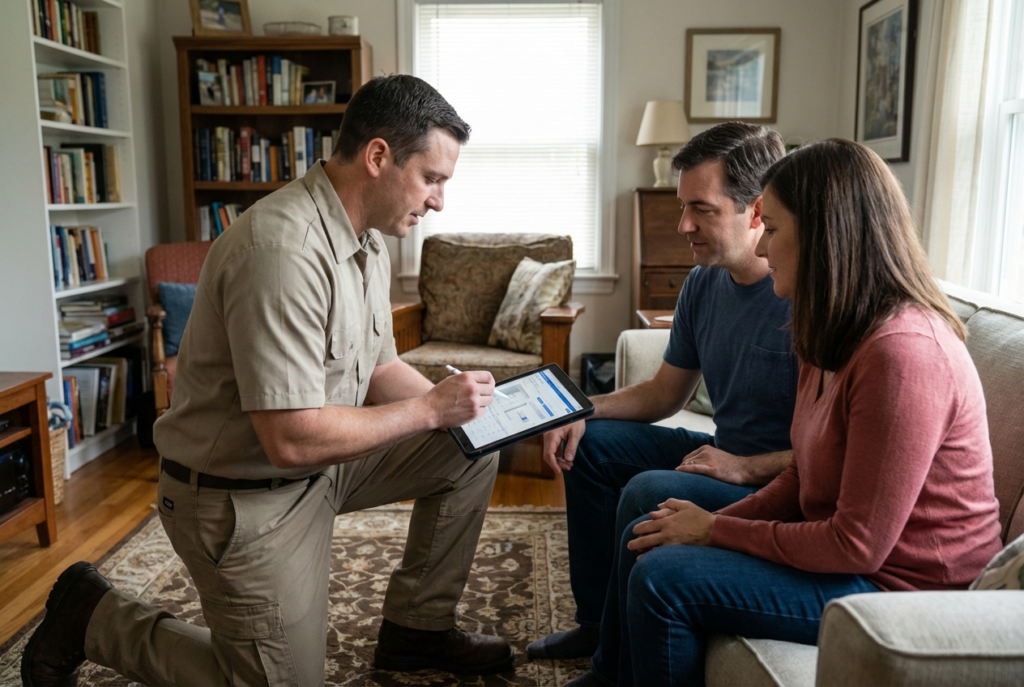
Furnace sizing isn’t about square footage—it’s way more complicated than that. Your house might be 2,000 square feet but need a different size furnace than your neighbor’s identical house depending on insulation, windows, ceiling height, how many exterior walls you have, which direction your house faces. Contractors who size furnaces by square footage alone are guessing and probably getting it wrong.
Oversized furnaces waste money and don’t heat evenly. Furnace fires up, blasts heat for three minutes, shuts off before your whole house warms up. Runs constantly in short bursts instead of long steady cycles. This is called short-cycling and it wears parts out fast. You paid for a bigger furnace thinking more power equals better heat but really you just bought an expensive problem.
Undersized furnaces run constantly trying to keep up and never quite get there. House drops to 65 on really cold days no matter how long the furnace runs. System works its ass off and still can’t maintain temperature. This burns out components from overwork and costs more in gas bills because it’s running 24/7. Proper sizing means calculating your actual heat load based on your specific house—not just picking a furnace off the shelf.
Gas vs Electric Furnaces – Which Makes Sense
Gas furnaces cost less to run but more upfront. Natural gas is cheaper than electricity for heating in most areas. Monthly heating bills with gas usually run $80-150 in winter. Same house with electric furnace might pay $200-300. Over a furnace’s 18-year lifespan that’s thousands in fuel savings. Gas furnaces cost more to buy and install because they need venting systems and gas line connections.
Electric furnaces make sense in specific situations. You don’t have natural gas service to your house and running a gas line costs $3,000-5,000. Or you’re in a small house where heating costs stay low anyway. Electric furnaces are simpler—no combustion means no venting, no gas lines, fewer things that can break. They’re safer because there’s no risk of gas leaks or carbon monoxide. Installation is cheaper and faster.
Climate matters too. If you’re heating a house in mild winters where the furnace barely runs, electric might make financial sense because you’re not burning much energy either way. Houses in cold climates with long winters benefit way more from gas because you’re heating constantly for months. Understanding home heating efficiency helps you decide which fuel type makes sense for your situation.
Single-Stage vs Two-Stage vs Modulating Furnaces
Single-stage furnaces have one speed: full blast. They’re either running at 100% or completely off. Cheapest option upfront at $2,500-4,000 installed. They work fine but run loud, create temperature swings, and cost more to operate because they’re always running full power even when you only need a little heat. Like driving a car where the gas pedal is either floored or off—it works but it’s not smooth or efficient.
Two-stage furnaces run at either 65% or 100% capacity. Most of the time they run on low stage which is quieter, more efficient, and maintains more even temperatures. High stage kicks in when it’s really cold and you need maximum heat. Costs $5,000-7,000 installed. Better comfort and lower operating costs than single-stage. This is the sweet spot for most houses—good balance of upfront cost versus long-term savings and comfort.
Modulating furnaces adjust output in 1% increments from 40% to 100%. Like cruise control constantly adjusting to maintain exact temperature. Quietest operation, most even heat, best efficiency. Costs $8,000-10,000 installed. Makes sense if you’re keeping the house long-term and value comfort and efficiency over upfront cost. Some people think they’re overkill for a basic furnace but others love never having temperature swings or loud blasts of heat.
What Proper Furnace Installation Actually Involves
Sizing calculations come first using Manual J load calculations. This measures your house’s actual heat loss through walls, windows, attic, basement. Accounts for insulation levels, air leakage, local climate. Takes 30-60 minutes of measuring and calculating. Contractors who skip this step and guess based on old furnace size or square footage are installing wrong equipment at least half the time.
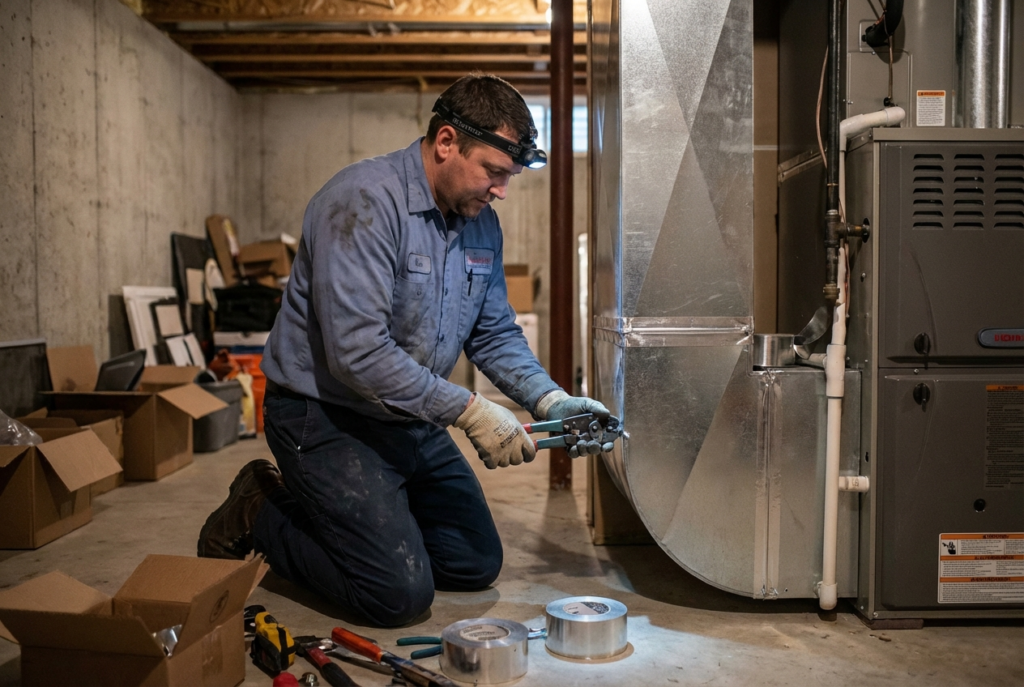
Removing old furnace and prep work takes several hours. Disconnect gas and electrical, unhook ductwork, remove old unit, inspect and repair ductwork connections, check flue pipe condition, verify gas line size is adequate for new furnace. Sometimes we find problems during removal—ductwork that’s falling apart, improperly sized gas lines, venting that doesn’t meet current code. These need fixing before installing new equipment.
New furnace installation includes setting the unit level, making all gas connections with proper thread sealant and pressure testing, running new condensate drain lines, connecting electrical with correct wire sizes and breakers, attaching supply and return ductwork with proper sealing, installing new thermostat if needed, setting up venting that meets manufacturer specs and local codes. Then we fire it up, adjust gas pressure, verify temperature rise, check for any gas leaks, make sure all safety switches work correctly. Rushed installation creates problems that show up as “mysterious failures” six months later.
Furnace Installation Costs and What Affects Price
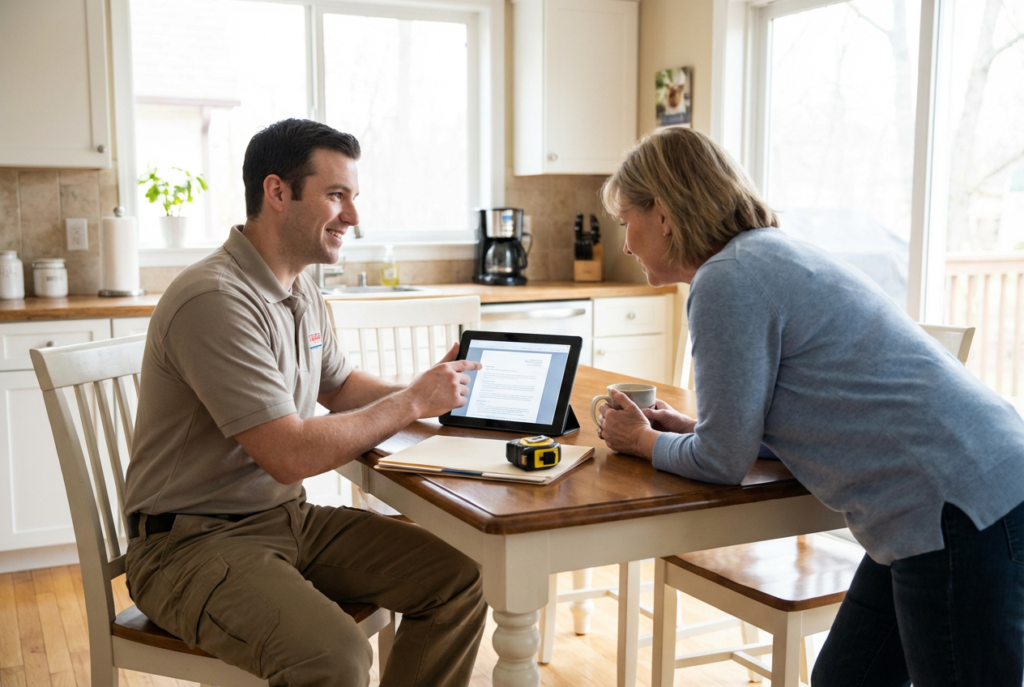
Basic single-stage 80% efficiency furnace installed runs $2,500-4,000 for a typical house. This is contractor-grade equipment properly installed. Big box store furnaces are cheaper but you get what you pay for in quality and warranty support. Mid-range two-stage 95% efficiency furnace costs $3,500-5,500 installed. Premium modulating 96-98% efficiency systems run $5,000-8,000 installed depending on size and features.
Labor makes up $1,200-2,000 of total cost. This includes proper sizing calculations, safe removal of old equipment, professional installation following manufacturer specs and local codes, startup and testing, hauling away old furnace. Cheaper quotes usually mean corners getting cut somewhere—improper venting, skipped load calculations, unlicensed installers, no permits pulled.
Add-ons increase total cost. New thermostat adds $150-400 depending on features. Upgrading electrical service if your panel is maxed out costs $500-1,500. Repairs to ductwork discovered during installation run $300-1,000. Permit fees are $50-150 depending on your city. Optional whole-house humidifier adds $400-800. Air cleaner or UV light system adds $500-1,200. These aren’t padding the bill—they’re actually needed work or useful upgrades worth considering.
How Long Furnace Installation Services in Oakville Take and What to Expect
Standard furnace replacement takes 4-8 hours from arrival to finished. Remove old furnace takes 1-2 hours. Installing new furnace takes 3-4 hours. Testing and adjustments take another 30-60 minutes. If everything goes smoothly we’re usually done same day. You have heat again that evening.
Complications extend the timeline. Old furnace is original 1970s equipment with asbestos wrap that needs professional removal—add a day. Ductwork is falling apart and needs repairs—add 2-4 hours. Gas line needs upgrading from half-inch to three-quarter-inch—add 2 hours. Electrical panel needs new circuit because old one is maxed out—add 2-3 hours. We don’t know about these problems until we get in there and start working.
Permits and inspections affect scheduling. Some cities require permits for furnace replacement. Permit takes 3-5 days to get approved. After installation the city inspector needs to come verify work was done correctly before we can close it out. Inspector might take 1-3 days to schedule. You can use the furnace while waiting for inspection—this is just paperwork not safety. Plan on the whole process taking 1-2 weeks from deciding to install until final inspection, even though actual installation is one day.
Questions You Should Ask Before Buying
Why Do Quotes Vary by Thousands of Dollars
You get three quotes for the same furnace model—$3,200, $4,800, and $6,500. What the hell explains a $3,300 difference? Sometimes it’s labor quality. The $3,200 quote is unlicensed guys who install fast and move on. No load calculations, improper venting, skip permit process. The $6,500 quote includes a bunch of add-ons you might not need. The $4,800 quote is probably the real cost of proper installation.
Some companies lowball to get in the door then hit you with “unexpected issues” that cost extra. Your quote was $3,500 but suddenly you need $1,200 in ductwork repairs they didn’t mention during the estimate. Or the gas line needs upgrading for $800. These aren’t scams necessarily—sometimes problems hide until you open things up. But good contractors inspect thoroughly before quoting and warn you about likely additional costs.
Brand markup varies wildly. Same efficiency furnace from Carrier versus Goodman might differ by $800-1,500. You’re not necessarily getting better equipment—you’re paying for brand name and fancier warranty. Premium brands cost more but don’t always last longer or work better. Mid-tier brands from reputable manufacturers work great for most people. Cheapest brands sometimes create parts availability problems down the road.
Should You Finance or Pay Cash
Contractor financing through their preferred lender often costs 8-12% interest. You pay $5,000 for a furnace, finance it at 10% for five years, you paid $6,350 total. Credit union or bank loans usually beat contractor financing by 3-5 percentage points. If you have decent credit, get your own financing before talking to contractors. Having cash or approved loan means you negotiate from strength instead of needing their financing.
“Same as cash” deals sound great but read the terms. Most are deferred interest—if you don’t pay off 100% before the promotional period ends, they charge you interest on the ORIGINAL AMOUNT dating back to day one. Miss the payoff by one month and your $5,000 furnace suddenly costs $6,200. These deals work if you’re disciplined about payoff but they’re designed to catch people who forget.
Energy rebates and tax credits offset costs. High-efficiency furnaces often qualify for $300-800 utility rebates plus federal tax credits up to $600. Factor these into your real cost when comparing quotes. That $5,500 high-efficiency furnace might actually cost $4,700 after rebates while the $3,800 standard furnace costs full price. Sales guys don’t always mention rebates because they want you focused on their quote amount, not real cost after incentives.
How to Spot Bad Installation Before It Becomes Your Problem
Furnace works fine for six months then starts having weird problems. Short-cycling, uneven heating, high gas bills, condensation issues. Turns out the installation was sloppy—ductwork poorly sealed, venting installed wrong, gas pressure never adjusted correctly. These problems aren’t obvious immediately but they show up once the system runs through a few months.
No load calculations = wrong size furnace. Ask contractors specifically if they’re doing Manual J calculations or sizing based on your old furnace. “Same size as what you had” isn’t proper sizing. Your old furnace might have been oversized from the start. Houses change over time—added insulation, new windows, finished basement. Proper sizing requires actual measurements and calculations, not guesswork.
Permits matter more than people think. Cities require permits for furnace installation to ensure work meets safety codes. Contractors who skip permits save time and avoid inspection but leave you holding the bag if something goes wrong. Insurance might deny claims for unpermitted work. Future home sales can get complicated when inspectors find unpermitted HVAC work. Permitted work costs $50-150 more but it means the city verified your installation was done safely and correctly.
Get Professional Furnace Installation in Oakville
Call (314) 600-2202 for furnace installation services in St. Louis. We size equipment properly, install to manufacturer specifications, and pull permits for every job. Free estimates with honest pricing and no pressure sales tactics.