Serving St. Louis & Surrounding Areas

Why Is My AC Running But Not Cooling? The Real Causes, Explained
Why is my AC running but not cooling? Honestly, it’s one of the more maddening things it can do to you. You can hear the fan. The outdoor unit’s buzzing away out back. Thermostat reads 72. And the house just sits there, warm, ignoring all of it. When a system runs and runs but never gets cold, one link in the chain that hauls heat out of your home has quietly given out. That’s what this page unpacks, in plain words. What’s going on inside the box, why the result is warm air no matter which part failed, and how a tech figures out which one it is. None of this fixes your unit tonight. But it lets you follow along when a technician tells you what they found, and it helps you smell the difference between a straight answer and a guess dressed up as one.
If your AC only started blowing warm today and you need something to do right this minute, don’t read the whole thing. Jump straight to our 10-minute warm-air self-check and work it step by step, then come back here if you want to understand what you found.
How Your AC Is Supposed to Make Cold Air
Quick basics first, because every failure below is just this one process breaking somewhere. Your air conditioner doesn’t make cold. It moves heat, that’s it. Warm air off your rooms gets dragged across an indoor coil packed with cold refrigerant. The refrigerant drinks up that heat, flashes to a gas, and hauls it out to the condenser in the yard, where the fan blows it off. Then it loops back in to do it again. For that loop to work you need three things at once. Enough refrigerant in the sealed lines. Enough air washing over both coils. And a compressor with the muscle to keep it circulating. Knock out any one of the three and the loop stalls. Your blower’s still shoving air through the ducts, but nothing’s chilling it, so what hits your face at the register is room temperature. Sometimes warmer.
A Refrigerant Leak: The Loop Runs Dry
Here’s the one people get lied to about the most. Refrigerant runs in a sealed loop. It’s not fuel. It doesn’t burn off or get used up over the years. So if you’re low, you didn’t run out, you sprung a leak, full stop. As the charge bleeds down, the coil grabs less heat on every pass, and your cooling quietly slips a little further each week until one day the vents feel plain warm. Where’s it leak on older Oakville systems? Usually the evaporator coil, the brazed joints out at the condenser, or a tired little valve at a service port. A real tech proves it with gauges on the lines, then goes hunting for the hole with an electronic sniffer, nitrogen, or UV dye. Not just topping it back up and calling it a day. That difference is a big deal, and if you’re wondering whether you can keep limping the system along while it leaks, we get into that in is it safe to run an AC with a refrigerant leak.
Low Airflow and a Frozen Coil: Starved for Air
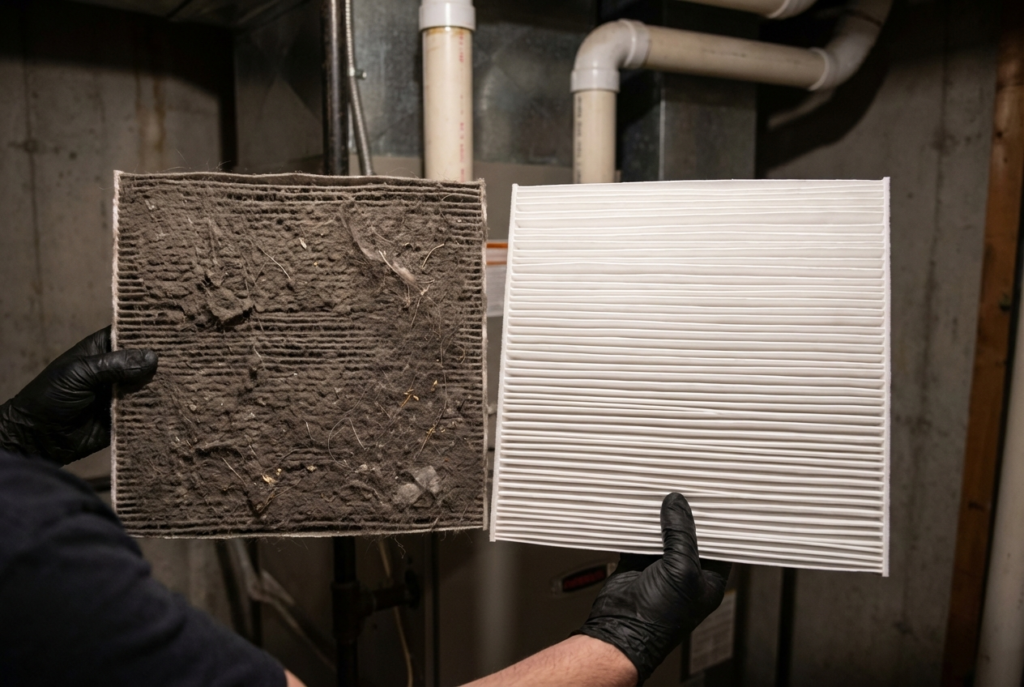
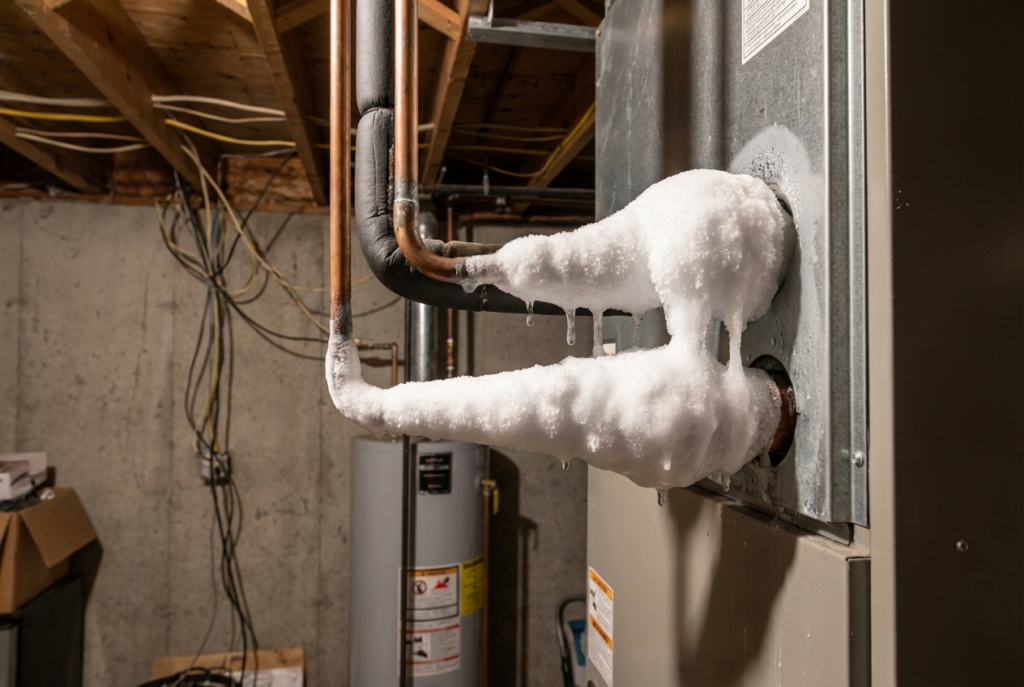
This is the one nobody sees coming. That indoor coil needs a steady wash of warm room air over it to work. Starve it of that airflow and the coil just keeps dropping colder, until the moisture riding on it freezes solid. Now picture that. A block of ice where a cold coil ought to be. And ice can’t trade heat, so the vents blow warm even while, technically, your AC is busy making ice cubes. Weird, but I see it every summer. So what strangles the airflow? A clogged filter is the usual suspect. But I’ve also traced it to a flex duct collapsed up in the attic, a blower wheel packed with dust, half the registers shut on purpose, or a return grille undersized from day one. The giveaway is frost on the copper lines at the indoor unit. A tech spots that ice, thaws it out, then measures the actual airflow across the coil to pin down what’s choking it. Why measure? Because a low refrigerant charge freezes a coil the exact same way, and that repair is nothing alike.
A Failing Compressor or Capacitor: The Pump Loses Its Muscle
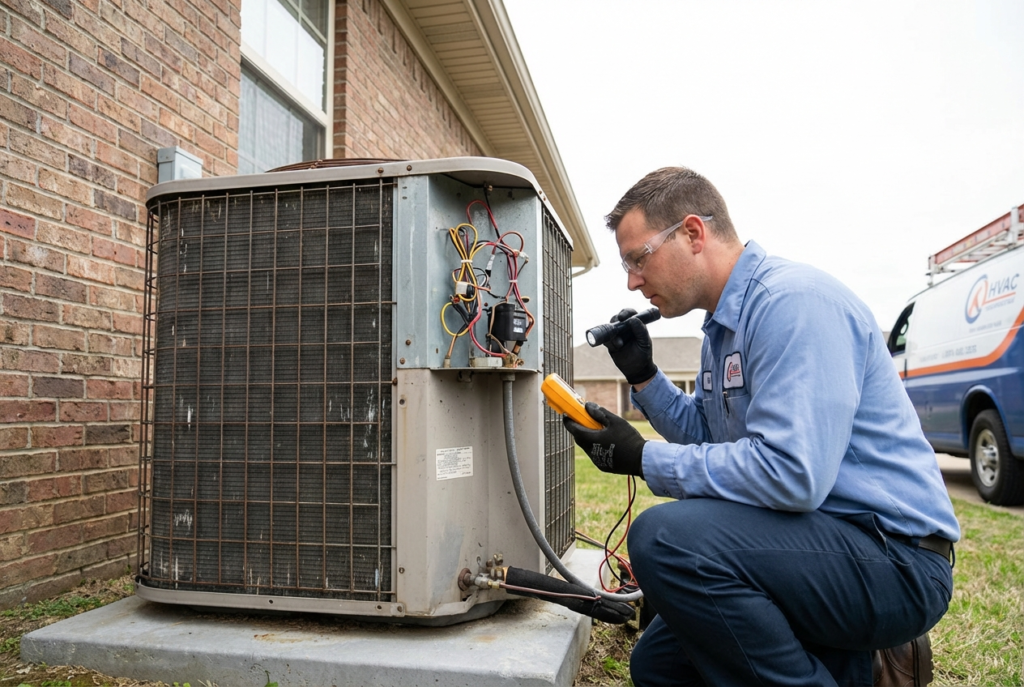
Think of the compressor as the pump that drives the whole refrigerant loop. The capacitor? That’s the little part that hands it the jolt to get moving. When a capacitor gets weak, the compressor lunges to start, can’t clear the hump, and you get that hum or click out of the outdoor unit while the fan half-heartedly spins, or doesn’t. When it’s the compressor itself going, it’ll run but stop building the pressure cooling depends on. So the unit sounds plenty busy while your rooms stay warm. Here’s the trap: from ten feet away in the yard, both look like a perfectly good AC. That’s why they get called wrong so often. A tech tells them apart by reading the capacitor with a meter and checking what the compressor pulls against the line pressures. The compressor’s the priciest chunk of the system, so you want this one called right. We walk through the warning signs in detail over in signs of a bad AC compressor.
Leaky Ductwork: Cold Air Lost in the Attic
Sometimes nothing on the equipment is broken and the cold air still never reaches you. Sounds impossible. It isn’t. Your ducts are the delivery route, and in a ton of homes they snake through a blazing attic nobody’s looked at in years. When those joints pull apart, or the old tape lets go, the system makes perfectly cold air and then dumps a fat share of it into that hot attic before it reaches a bedroom. What you feel at the register is weak, lukewarm airflow, even though the coil’s doing everything right. And it cuts both ways. Leaky returns will suck hot attic air back into the system and blend it in with the good stuff. A tech runs this down by comparing the temperature drop across the equipment against what’s really coming out of your vents. It’s a cause the parts-swap pages skip right over, because there’s no broken part to point at.
An Undersized System: Always Running, Never Winning
Does your AC run flat-out all day on the hot ones and still leave the house a few degrees warmer than you set it? The unit might just be too small for what you’re asking it to cool. I see this most on additions, finished basements, and houses where somebody knocked out a wall or put in big windows years after the AC got sized. Nothing’s broken. The unit runs and runs and just can’t win the race once it gets hot enough outside, and from the couch that feels exactly like a failure. A tech sorts this out with a load calculation, weighing your square footage, insulation, windows, and layout against what the equipment can put out. The answer isn’t a repair. It’s matching the equipment to the house, a whole different conversation than swapping out a dead part.
Thermostat Placement and Control Faults
Last one, and it’s the brain, not the body. Stick a thermostat somewhere it doesn’t belong, in a sunbeam, above a supply vent, or on a wall with a hot kitchen behind it, and it reads a temperature the rest of the house never feels. So it figures it’s done and shuts the cooling off early. The far bedrooms never catch up. Control gremlins pull the same stunt from another angle. A smart thermostat wedged in eco or geofence mode. A loose C wire. A low-voltage wire a mouse chewed through out to the condenser. Any of those cuts off the call for cooling. A tech checks what the thermostat thinks it sees against the real room temperature, then makes sure the signal’s even reaching the outdoor unit. Quick to rule out, and you’d be surprised how many “runs but won’t cool” calls come down to this while the equipment’s fine.
How a Technician Narrows Six Causes to One
Here’s the catch with all six. From the vents, they look identical. Warm air is warm air, whether the culprit is a leak, a frozen coil, a tired compressor, leaky ducts, an undersized unit, or a thermostat in the wrong spot. That’s why guessing runs rampant in this trade, and why it costs people so much. A real diagnosis works backward through the heat-moving loop with instruments. Gauges on the refrigerant. A meter on the capacitor and compressor. A temperature reading across the coil, then again at the registers to see if the cold’s getting lost on the way. A look at the airflow and what the thermostat’s really reading. One by one, each test rules a suspect out until you’re left with the one that did it. That’s the gap between a tech who tells you exactly what failed and a guy who throws a part at it and hopes.
Get a Straight Diagnosis From Liberty
When you’d rather know the real answer than keep guessing, that’s where we come in. Liberty Heating Cooling & Plumbing is based in Oakville, and Sam has spent 27 years diagnosing exactly these problems on South County systems, so he knows how to read a unit that runs but won’t cool. We carry the gauges and meters to test the whole loop instead of eyeballing it, and we explain what we find in plain language before any work starts. You’ll never get talked into a part we didn’t prove was bad. We’re a family-owned outfit, licensed, bonded, and insured, reachable every day of the week including weekends and holidays, and we take 10 percent off for customers 65 and older.
Call (314) 600-2202 or schedule AC repair in Oakville online, and we’ll pin down which of these six causes is behind your warm air.
Questions About an AC That Runs But Won’t Cool
Why does my AC run all day but the house never gets cold?
Because the equipment is moving air but not moving heat. Something in the loop has failed: low refrigerant from a leak, a coil starved of airflow, a weak compressor, cold air escaping through leaky ducts, or a system that’s simply too small for the space. Each one leaves the fan running while the rooms stay warm.
Can leaky ductwork really make my whole house feel warm?
Yes. If ducts run through a hot attic and the joints have come apart, the system makes cold air and then loses a large share of it before it reaches your rooms. Leaky returns can also pull hot attic air back into the mix. The equipment tests fine, but the delivery is broken, so the airflow at your vents feels weak and lukewarm.
How can a technician tell one cause from another when they all blow warm air?
By testing the heat-moving loop with instruments instead of guessing. Gauges read the refrigerant pressures, a meter checks the capacitor and compressor, and a temperature reading taken across the coil and again at the registers shows whether the cold air is being made and whether it’s actually reaching you. Each test rules a suspect in or out.
Could my thermostat be the reason my AC runs without cooling?
It can be. A thermostat sitting in sunlight, above a vent, or on a hot wall reads the wrong temperature and shuts cooling off too early, so distant rooms never catch up. Control faults like a stuck eco mode or a loose wire do the same thing. It’s quick and inexpensive to rule out, and it’s a common surprise culprit.