Serving St. Louis & Surrounding Areas


What’s the First Thing to Check When Your AC Stops Working in Oakville?
The first thing to check when AC stops working in Oakville is your thermostat. Walk over, make sure it is set to COOL, swap the batteries if it takes any, and drop the set point five to ten degrees below whatever the room currently reads. About a third of “my AC quit” calls Sam takes end at the thermostat. Dead batteries, wrong mode, a kid bumping the schedule. Cheapest fix you will ever do.
Now, if the thermostat is dialed in and the system still will not run or will not cool, the real answer gets a little wider. There are five or six other things a homeowner can sanity-check in about ten minutes before picking up the phone. Most of them are not glamorous repairs. They are filters, breakers, a pull-out disconnect outside, a float switch in the basement. Boring stuff that shuts a healthy system down on a regular basis.
We are Liberty Heating Cooling & Plumbing, based right here in South St. Louis County. Sam has been working on AC systems in South St. Louis County for 27 years and would honestly rather you check these few things first than drive out for a problem you could have fixed in five minutes. If the checklist below does not bring the cooling back, that is when you want to schedule a service call with our team and have someone look at it properly.
Here’s everything you need to know about the first thing to check when AC stops working in Oakville:
- Thermostat first. Mode, batteries, and the set point relative to room temp.
- Air filter second. A clogged filter trips a safety and kills the system.
- Breaker panel third. AC has two breakers in most homes, not one.
- Outdoor disconnect fourth. The pull-out box near the condenser gets bumped.
- Float switch fifth. A backed-up condensate drain shuts cooling down hard.
- Outdoor unit last. Watch and listen for ice, silence, or a humming-but-not-spinning motor.
The Quick Answer Before You Call Anyone
Walk to the thermostat first. Not outside. Not down to the basement. Just the thermostat. Set it to COOL, not AUTO and not FAN. Look at the room temperature on the screen and drop the set point at least five degrees below that number. A healthy system kicks the indoor blower on within a minute, sometimes two.
Screen blank? Screen lagging? Pop the cover and check the batteries. A lot of folks assume a hardwired thermostat does not use batteries, but most of them do. Two AAs is the usual setup. Dead batteries leave the display alive enough to look fine but kill the relay signal that actually tells the equipment to fire. Sam carries a fresh pack in his truck because this comes up almost weekly.
Smart thermostats have their own trap. Schedules, geofences, an “eco” override from the app, a software update that reset preferences. Open the app, see what mode is really active, and force cool from your phone. The thermostat runs everything else. If it is confused, the rest of the system never even hears the call. One out of every three “AC is dead” trips that Liberty rolls on ends right here, at the wall, with no parts swapped.
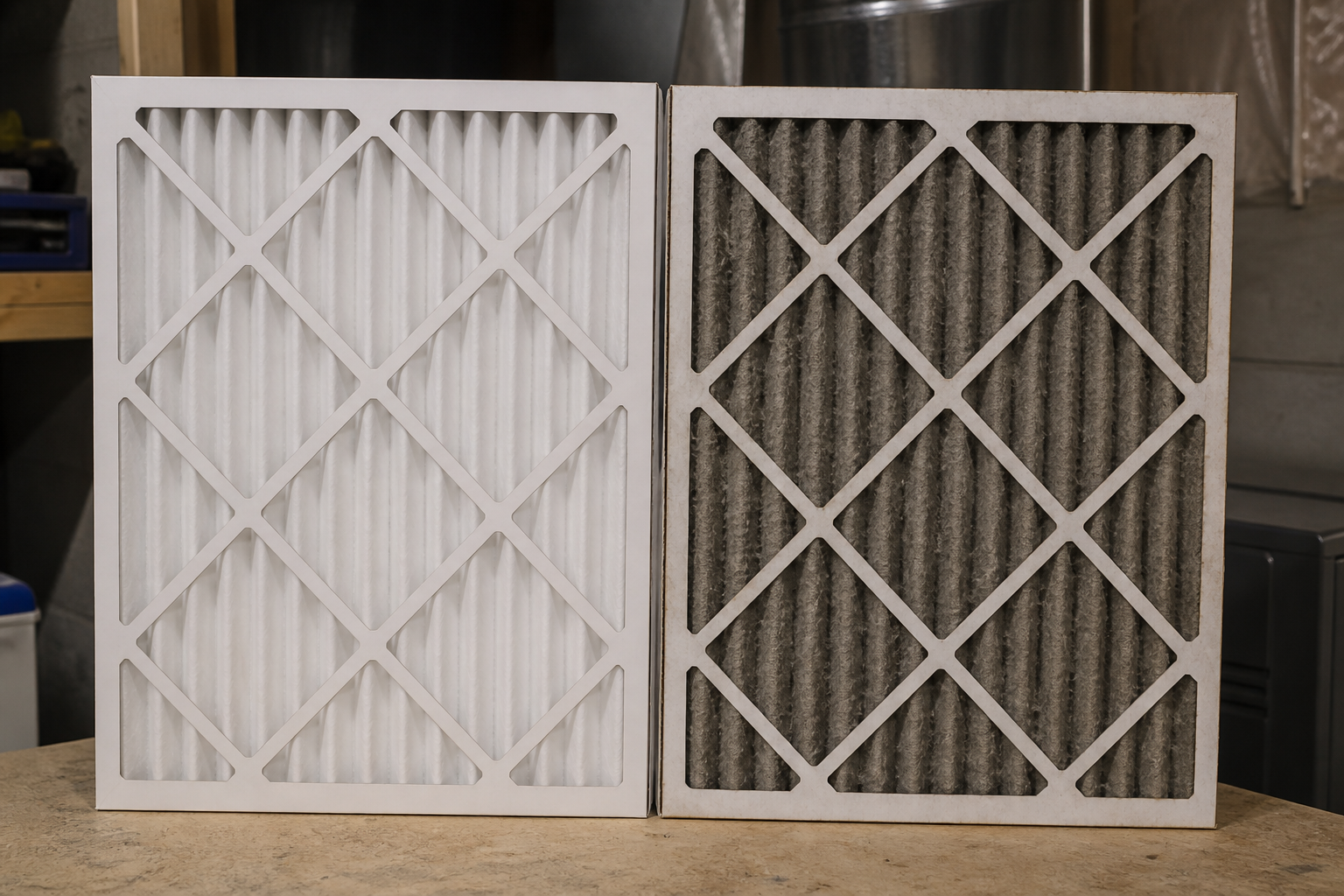
Check Your Air Filter, Because a Dirty One Will Shut the System Down
Most homeowners are caught off guard by this one. A clogged filter does not just make the system weak. On almost every modern AC, it can shut the unit down completely through a built-in safety. When airflow over the indoor coil gets choked off, the coil drops below freezing, ice builds up, and a sensor tells the system to stop running before something pricey breaks.
Yank the filter out of the return grille, or out of the slot at the air handler if that is where yours lives. Hold it up against a light. Cannot see light through it? Looks gray, fuzzy, matted with dust? That is your problem right there. Homes in South St. Louis County usually need a fresh filter every one to three months, more often if you have pets or anyone with allergies, more often if the system runs all day in July.
Here is the part nobody warns you about. If the coil is already iced over when you pull the bad filter, swapping it in will not bring cool air back right away. Switch the thermostat to OFF, set the fan to ON, and walk away for two to four hours so the ice can melt fully. If you skip that, the coil re-freezes inside of fifteen minutes and you are back where you started. Whole thing is a Saturday afternoon win that costs you the price of a filter.
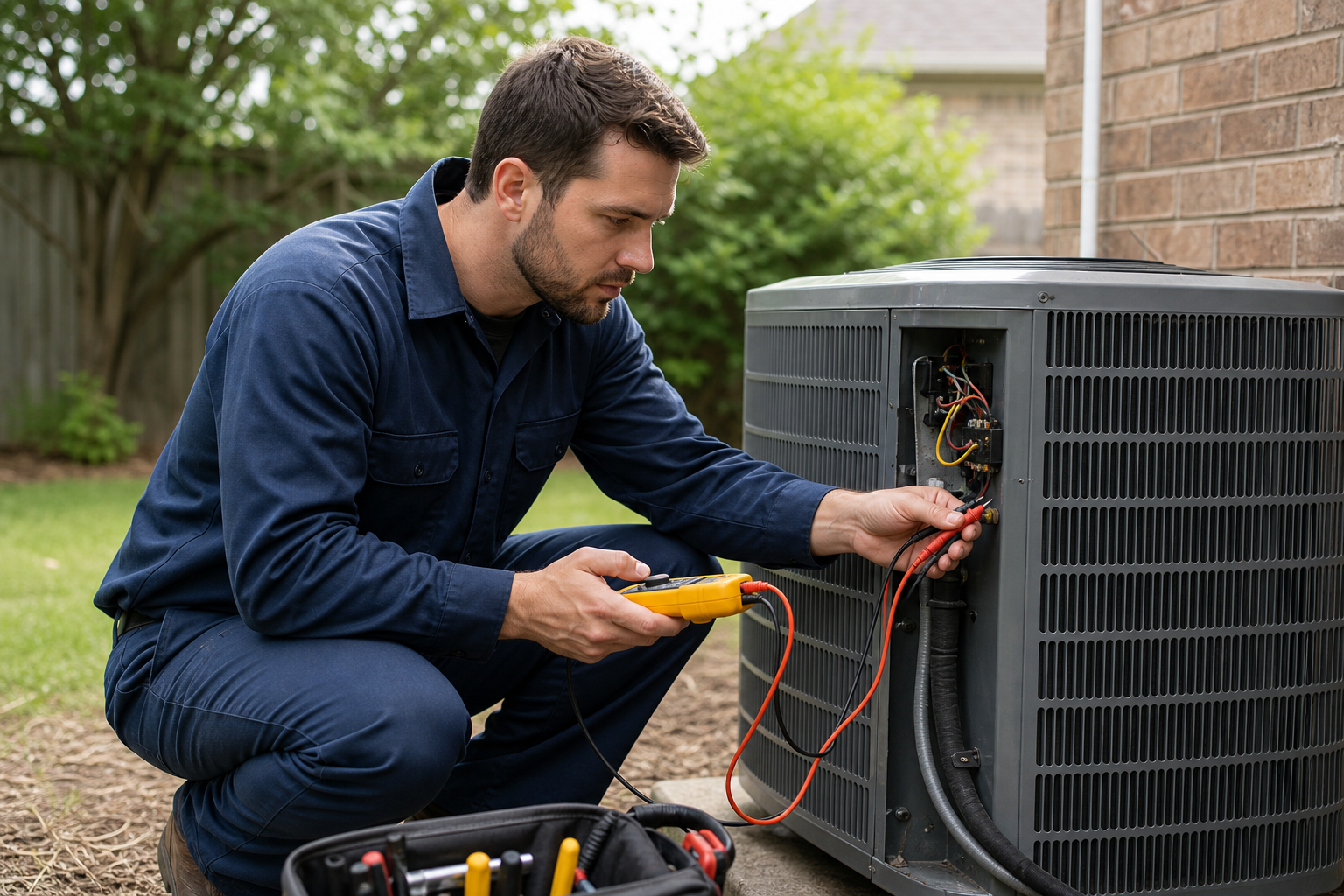
Both Breakers, Not Just One, Because Most AC Systems Have Two
Catches people off guard every time. A central AC setup in most homes around here almost always has two breakers in the main panel, not one. The indoor blower or furnace runs off one breaker. The outdoor condenser runs off a separate, bigger one. If either of those is tripped, you get no cool air. Could be no air at all, depending on which side flipped.
Pop the panel cover and scan every breaker. A tripped one usually sits a hair off-center, sort of stuck between ON and OFF, not all the way at OFF. Shove it firmly to OFF first, then back to ON. If it trips again right away, walk away from it. That is the system telling you there is a short or an overload somewhere, and that is when you stop being a hero and pick up the phone. Repeatedly resetting a tripping breaker is a great way to burn something out.
Older homes in South St. Louis County, especially the ones built in the sixties and seventies, sometimes use a fuse for the AC instead of a breaker. The fuse lives in a little box bolted to the wall next to the outdoor unit. Blown fuses look discolored, sometimes cracked, sometimes outright burnt. Swapping a fuse is a hardware-store job if you know the amperage and you are okay working around live voltage. If that whole sentence made you uncomfortable, that is fair, leave it for someone wearing the right gloves.
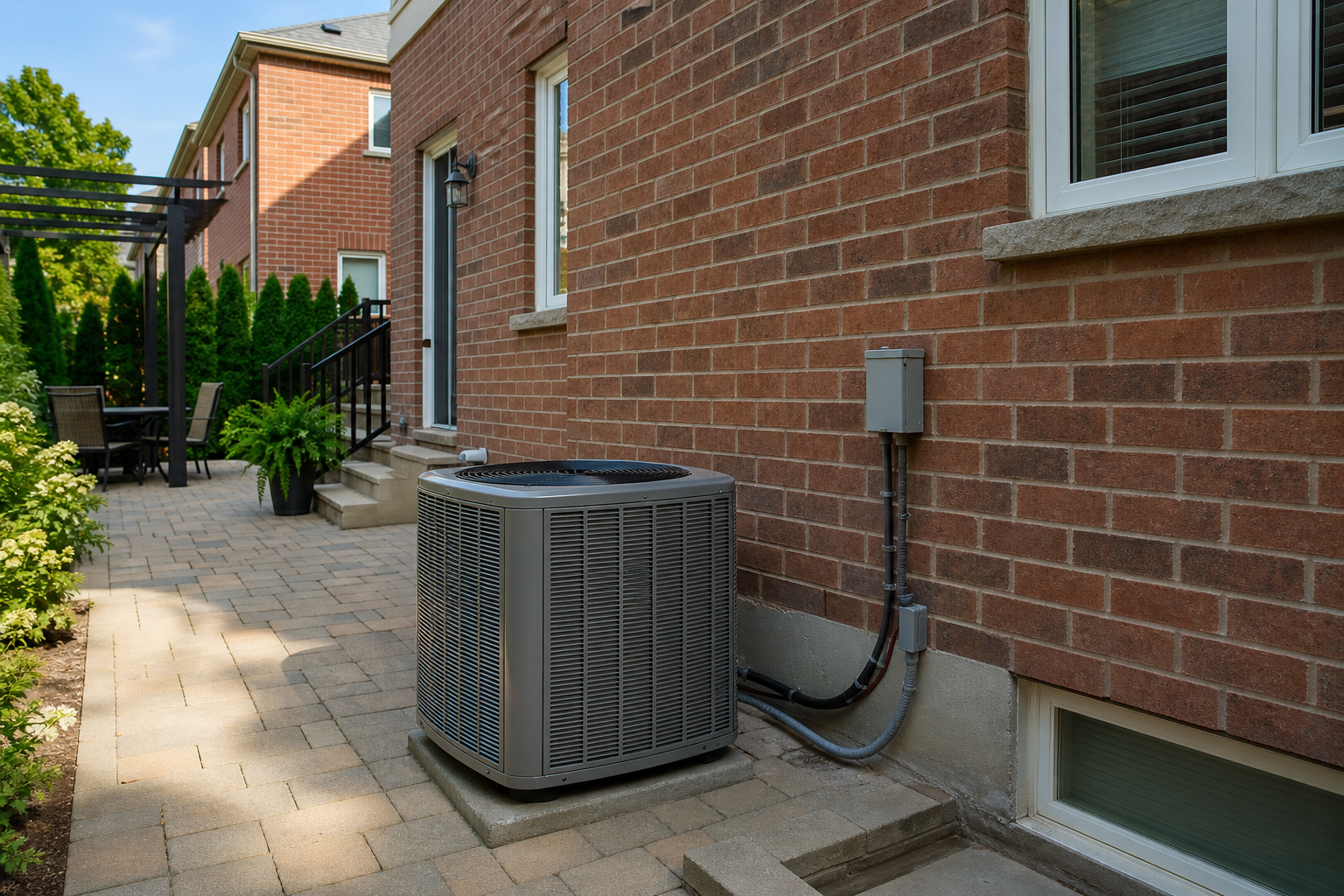
The Outdoor Disconnect and the Float Switch in Your Basement
These two get skipped over almost every time. Walk out to the condenser. Look at the wall of the house right next to it. There is a small gray or beige box bolted there. That box is the disconnect. Most of them have a plastic handle that pulls straight out and pushes straight back in. Lawn mower clipped it last weekend? Mulch shoved against it? A kid running through the yard with a stick? Sometimes it sits loose just enough to kill power but not loose enough to look obviously off. Yank the handle all the way out, count to three, push it all the way back in until you feel it click home.
Now head down to where the indoor air handler lives. For most South St. Louis County homes that means the basement. Look at the base of the air handler. You are hunting for a small white plastic pan, or a PVC pipe coming off the indoor coil. Tucked somewhere along that drain path is a float switch. When the drain line clogs up with algae buildup or basement dust, water has nowhere to go, the float rides up, and the AC kills itself on purpose so your basement does not turn into a wading pool.
Standing water sitting in the pan? Damp ring of insulation under the air handler? Bingo. Grab a wet-dry shop vac, walk outside, and put the hose on the open end of the condensate line where it pokes out of the wall. Run it for five minutes. The clog usually rips loose and water comes out the other end. Once the pan drains and the float drops, the AC fires back up. Older basements in this part of South County are famous for this exact problem and most folks never even know that little switch exists until somebody points it out.
What the Outdoor Unit Itself Is Telling You
Last stop in the homeowner checklist. Stand next to the outdoor condenser and look at it. Listen for about thirty seconds. You are checking for three patterns.
Pattern one is silence. Nothing is happening. Fan is not spinning, no humming, no clicking. That usually points back to power. Disconnect, breaker, or fuse. Go recheck those.
Pattern two is humming with no fan spin. The compressor or fan motor is getting power but cannot start. Sometimes this is a bad capacitor, which is a small cylinder-shaped part inside the unit. A capacitor is a real repair, not a DIY job, because the part holds a charge even with the power off. If you hear humming with no spin, kill power at the disconnect to protect the compressor and call us. Letting it hum for an hour can cook the motor.
Pattern three is ice on the copper lines or on the unit itself. That ties back to the airflow problem from the filter section above, or it can be a refrigerant issue. Either way, shut the system off, let it thaw fully, and if it ices again after a clean filter and a thawed coil, you have a real problem worth booking a diagnostic for. If your checklist made it all the way here without solving things, this is the point where it makes sense to get it looked at professionally.
Why Oakville Homeowners Trust Liberty Heating Cooling & Plumbing With AC Diagnostics
The reason Liberty is willing to publish a checklist that might cost the company a service call is simple. Sam has been doing this for 27 years in South St. Louis County and he would rather build a long-term customer than charge somebody a trip fee for a flipped breaker. The homes around Oakville, Concord, Lemay, Mehlville, and across the river in Monroe County all have their own quirks. Older basements with float switches that clog. Outdoor disconnects that sit at lawn-mower height. Two-breaker panels that confuse new owners. Sam has seen all of it.
Liberty is family-owned, licensed, bonded, and insured. We offer a 10% discount for seniors. We are available seven days a week including weekends and holidays, and same-day service is the norm, not the exception. When the checklist above does not solve the problem, the diagnostic on the next visit is methodical, not a parts-swap guessing game.
We also tell you when something is not worth fixing. If a 22-year-old condenser dies on a 95-degree day, we will say so. If a small capacitor brings the unit back, we will say that too. Honest answers either way. If you want a real set of eyes on the system after running through this list, contact our team for a diagnostic and we will be out same day in most cases.
Worked the Checklist and Still No Cool Air? Here’s the Next Move
Ran every step above and the unit still will not fire? Still blowing warm? Tripping a safety the moment you reset it? At that point you are past what a homeowner can fairly chase down with a flashlight and a screwdriver. Honestly, that is fine. It just means the next stop needs gauges, a multimeter, and somebody who has had their hands inside a few thousand of these things. Usual suspects from this point on are a tired capacitor, a contactor that will not pull in anymore, a slow refrigerant leak that finally dropped charge below the cutoff, or a compressor coughing its last. Each one is a different fix. Throwing parts at it blind gets expensive in a hurry.
If you want a plain-English read on what is actually inside the box outside and how central cooling works, the U.S. Department of Energy has a solid guide over at energy.gov. Ten minute read, no jargon, worth it.
When you are ready for real hands on the system, call Liberty Heating Cooling & Plumbing at (314) 600-2202 or book online. Seven days a week, weekends and holidays included. Same-day service across South St. Louis County, plus the Metro East side over in Monroe County IL.