Serving St. Louis & Surrounding Areas

What Are the Most Common AC Repairs in Oakville Homes?
The most common AC repairs in Oakville are capacitor failures, refrigerant leaks, contactor problems, frozen evaporator coils, fan motor burnouts, and thermostat glitches. Out of those, a bad capacitor is the runaway number one. If your unit hums but the fan won’t spin, or the system kicks on then quickly shuts down, a small inexpensive part inside the outdoor unit is usually the culprit.
The honest version of this story is that “my AC is broken” almost always means one of six things, and most of them are not big jobs. Some are 20-minute fixes once a tech has the right part on the truck. Others need more time, a sealed-system tool kit, and a deeper look. The trick is sorting which one you actually have before someone hands you a quote for a new system.
Sam at Liberty Heating Cooling & Plumbing has been working on air conditioners across South St. Louis County for 27 years, and he has seen the failure pattern repeat for every type of home in the area. If you want a contractor who will tell you the cheap fix first when the cheap fix is the right answer, take a look at our AC service options for Oakville homes.
Here’s everything you need to know about the most common AC repairs:
- Why capacitor failures top the list around here
- How refrigerant leaks actually show up in a home
- What a bad contactor does to your system
- Why your coil keeps freezing over
- When a fan motor is the real problem
- How to tell if it’s just the thermostat
The Short Answer on the Six Repairs That Cover Almost Every Call
Walk up to the unit and listen. That’s where any honest diagnosis starts, and it tells you more than most people think. Around here, if the AC gave up overnight in July, the smart money is on a capacitor. We pull more of those than every other part combined, and it’s not even close.
After that one, the list shortens fast. A small refrigerant leak in the line set or evaporator coil. A pitted contactor that won’t pull in. An evaporator coil so iced over it looks like a Frigidaire commercial. A condenser fan motor or blower motor that finally quit. A thermostat that’s either dead, miswired, or out of batteries because someone forgot to swap them. Six things. That’s basically the whole call sheet.
Quick gut check before you pick up the phone. Hear a hum outside but the big fan blade isn’t spinning? Capacitor. Unit runs fine but the vents are blowing room-temp air? Refrigerant or a frozen coil. Nothing comes on at all? Contactor, breaker, or the thermostat. None of this replaces a real look at the system, but it points you at the right kind of visit.
Capacitor Failure: Why It Tops the List Every Summer
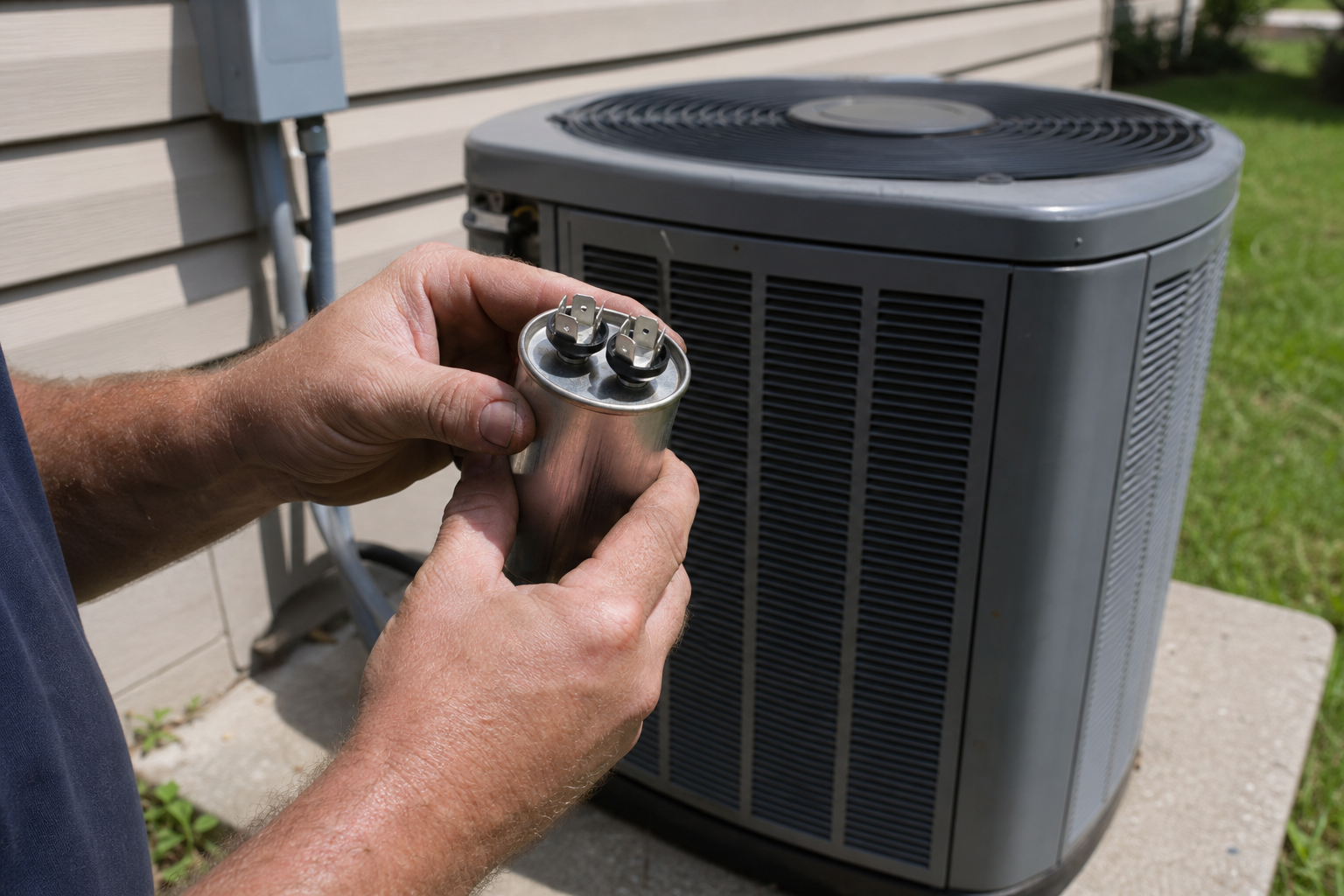
The capacitor is a small soda-can-shaped piece bolted inside your outdoor unit. Its job is dead simple. It stores up a little jolt of electricity and dumps that jolt into the fan motor and compressor every time the system kicks on. Without that kick, neither motor has the muscle to start.
Why does it fail so often around here? South St. Louis County summers beat the snot out of it. The unit runs hard most of the day, rests a few hours, then does it again tomorrow. Every single start chips away at the capacitor’s lifespan. Caps that might cruise along for a decade in a cooler climate often tap out at five or six years in this part of South County. After 27 years working units up and down the county, Sam can pretty much guess the age of a condenser by how puffy the top of the capacitor looks when he pops the panel.
How do you spot it? The big outdoor fan won’t spin but you hear the unit humming. The system clicks on then shuts right back down. You give the fan blade a push with a stick and it suddenly takes off on its own. The top of the capacitor is bulged up like a swollen battery. Any one of those means cap. It’s a small inexpensive part and about twenty minutes of work on a service call. Anybody trying to sell you a compressor before they check this one is either lazy or hoping you don’t know better.

Refrigerant Leaks: Why “Topping It Off” Is the Lazy Fix
Refrigerant is not a consumable. The system is a sealed loop. So if you’re low on refrigerant, you have a leak. Period. Anybody who pulls up with a tank and offers to “top you off” without finding where it went is doing you wrong, and that’s one of the most common bad-faith moves in this business.
Around St. Louis, leaks tend to hide in three spots. The Schrader valves on your service ports (little tire-valve-looking things) sometimes back themselves out and weep slowly. Copper line sets get rub spots from where they pass through walls or sit against a joist, and a pinhole opens up. And the evaporator coil up in the air handler develops tiny pinhole leaks from years of formicary corrosion. Older South St. Louis County homes catch the coil version most often, just because the coil’s been up there longer.
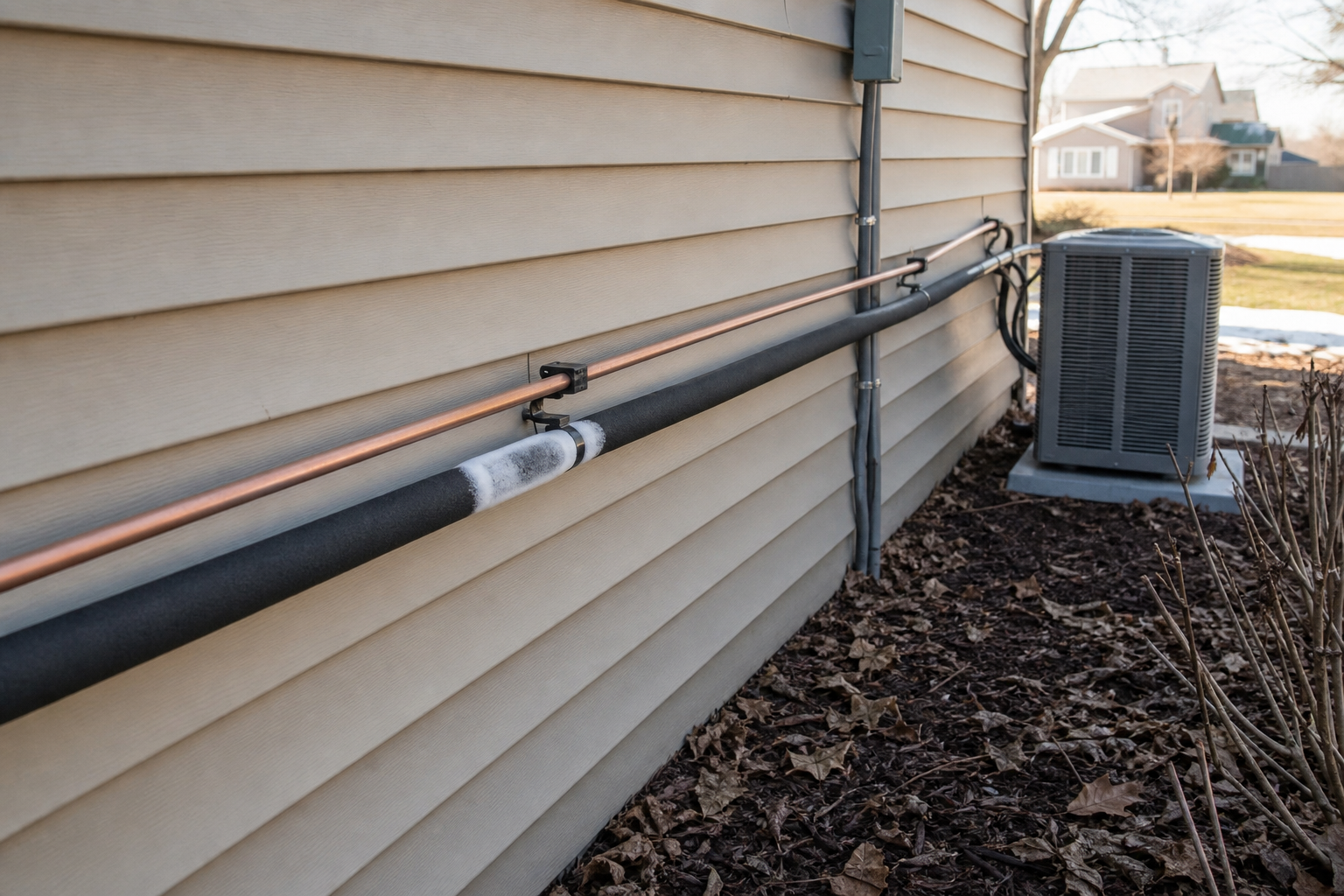
Symptoms to watch for. Vents blowing room-temp or warm air even though everything sounds normal. Ice creeping up the copper line outside. Your power bill spikes because the system never reaches setpoint and just runs and runs. A soft hissing noise near the indoor coil. Real repair means hunting the leak with electronic detection or UV dye, fixing or swapping the leaking part, pulling a deep vacuum, and recharging to whatever the unit’s data plate says. Skip any of those steps and you’re scheduling the same call again in a few months. Mystery leaks like these are exactly what our cooling diagnostic team in Oakville sorts out the right way.
Contactor Failure: The Relay That Quietly Burns Itself Out
The contactor is the relay that tells your outdoor unit “go.” When the thermostat calls for cool, low-voltage power energizes the contactor coil, which pulls two big contacts together and sends high-voltage juice to the compressor and fan. It clicks thousands of times every summer. After a few years, those contacts pit, burn, or get stuck.
Three failure modes show up in South County homes. Pitted contacts that arc but don’t fully connect, so the unit hums and tries to start but never really gets there. Stuck-closed contacts where the unit will not shut off even when the thermostat is satisfied (you’ll feel a wall of cold air that doesn’t quit, and your electric bill catches it about three weeks later). Or the coil that pulls the contacts together burns out, and nothing happens at all. The fix is to swap the contactor for a matching-rating part, takes about thirty minutes.
A pro tip Sam shares with customers: pop the disconnect (the box on the wall next to the outdoor unit) and peek at the contactor through a flashlight when the system is off. If you see two black, burned, or corroded squares where the contacts meet, that part is on borrowed time. It’s a cheap fix done early and a much bigger fix done late, because a failing contactor sometimes takes the compressor with it when it finally gives up.
Frozen Evaporator Coils and Failed Fan Motors
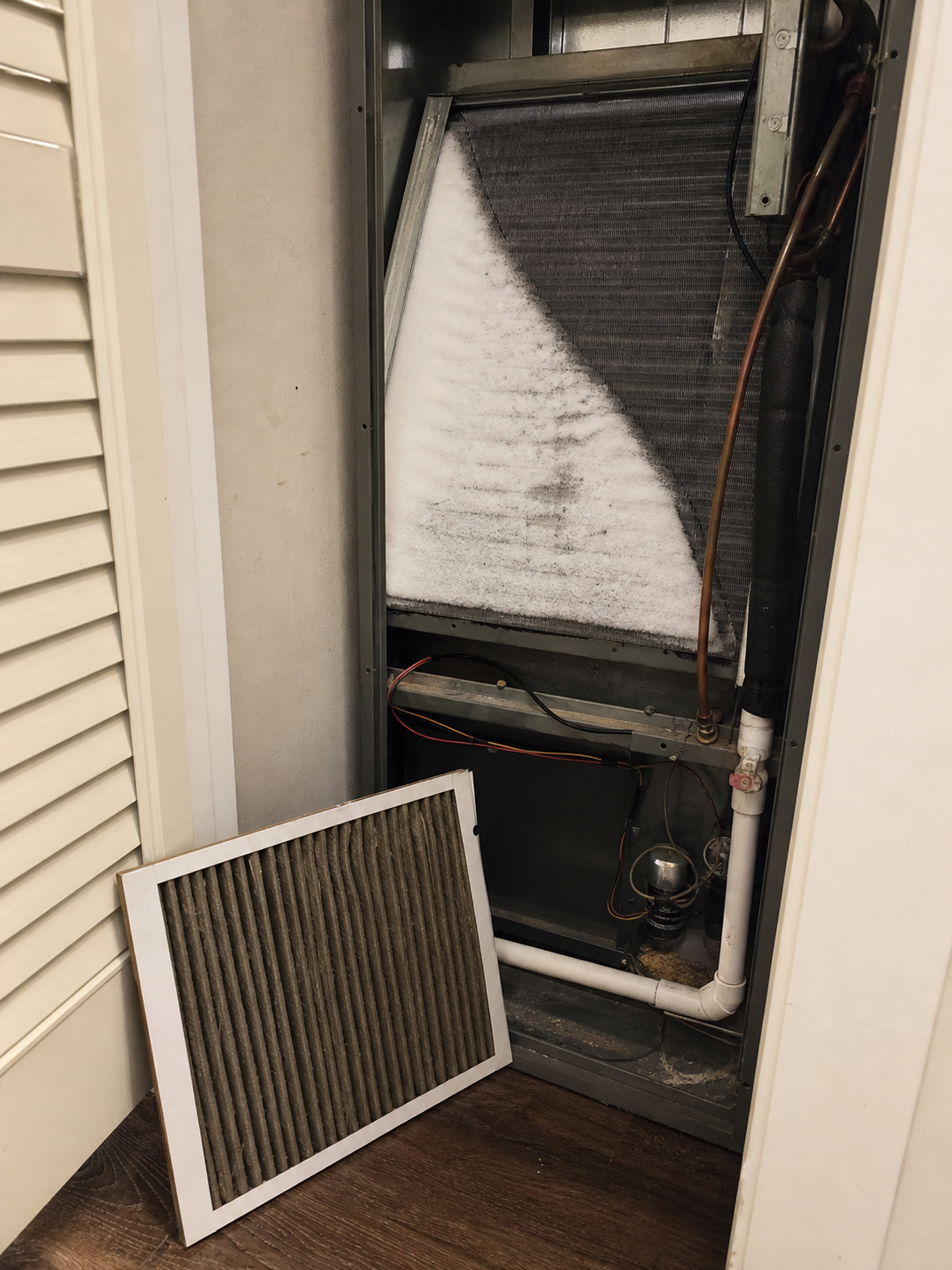
A frozen evaporator coil looks ugly but it’s basically the system telling on itself. You’ll see a chunk of ice on the copper line by the air handler, or water dripping out the vents and pooling under the closet. When that happens, shut the AC off at the thermostat right then. Let it thaw. Running it with a block of ice on the coil just stresses the compressor and gets you nowhere.
Coils freeze for one of two reasons, basically. Either no air is moving across the coil (clogged filter, half-closed registers, gunked-up blower wheel, a duct that got kinked or stepped on), or the system is low on refrigerant from a leak and the coil temperature drops below freezing. We see the filter version a lot in South St. Louis County. About half the frozen-coil calls trace back to a filter that’s been in there since Christmas. Sam tells people the same thing every time: a fifteen-dollar filter every two months keeps you out of trouble.
If it isn’t the coil, look at the fan motors next. There are two. The condenser fan motor outside, which dumps heat off the refrigerant. The blower motor inside, which pushes cooled air through your ducts. They fail differently. Outdoor motor goes bad and you hear the unit running but the top fan blade just sits there (which is why a real tech checks the capacitor first to rule that out). Blower motor goes bad and the air handler stays dead quiet even though the thermostat says it should be working. Motors aren’t pocket change to replace, but on a unit under fifteen years old it’s almost always smarter than starting over with a brand new system.
Thermostat Issues and When to Stop DIY-ing and Call a Pro
Before you spend a service call on anything else, check the thermostat. We have rolled trucks to “broken” AC units more times than we can count, only to find dead batteries in the wall thermostat. It happens with brand-new smart thermostats too. Pop the cover, look for low-battery icons, swap the AAs, and try the system again.
The other homeowner-fixable thermostat issues: the unit got bumped into “heat” or “off” by accident, the temperature setpoint is above current room temp so the system has no reason to run, or a circuit breaker in the panel tripped overnight after a storm and the thermostat went dark when it lost power to the air handler. Reset the breaker once. If it trips again, stop and call somebody. That’s electrical and you don’t want to mess with it.
When does it stop being a DIY problem and start being a pro problem? Any time the issue points at the refrigerant circuit, the electrical side of the outdoor unit, a motor that needs replacement, or a coil that has frozen more than once. EPA rules say only a certified tech can handle refrigerant work, and the electrical inside that condenser will hurt you if you touch the wrong thing. If you’ve changed the filter, reset the breaker, swapped the batteries, and you’re still warm, that’s the time. You won’t find a faster turnaround in South St. Louis County than our same-day team when you need somebody out the same afternoon.
Why Oakville Homeowners Trust Liberty Heating Cooling & Plumbing With AC Repairs
Twenty-seven years of pulling apart AC units across South St. Louis County means Sam has seen every one of these failures hundreds of times. That’s not a marketing line. That’s what pattern recognition looks like in this trade. He can usually walk up to a unit, listen for ten seconds, look at the model and age, and know within a couple of guesses what’s wrong before the panel is even off. That kind of speed comes from working on the same housing stock for almost three decades.
Liberty Heating Cooling & Plumbing is family-owned and we’re licensed, bonded, and insured. We run same-day service seven days a week including weekends and holidays, because AC problems don’t take Sundays off in July. We’re an honest shop. Capacitor jobs get quoted as capacitor jobs. Coil leaks get quoted as coil leaks. You won’t get a sales pitch for a $12,000 system replacement on a $200 repair. Seniors get 10% off automatically.
The reason this matters specifically for the most common AC repairs around here is that diagnosis accuracy is everything on these calls. Get it wrong and you replace a $200 part this week and a different $200 part next week, and you still don’t have cold air. Get it right and you’re done in one visit. If you want somebody who shows up fast and tells you the cheap fix first when the cheap fix is the right fix, give our Oakville AC team a call next time the house gets warm.
Dealing With One of These Repairs Today? Here’s How to Get It Fixed
If you’re reading this with a warm house and an AC that’s either silent or making noises it shouldn’t, you’re in the right spot. You now know the six things it’s probably going to be. You also know that most of them are honestly not a huge deal. The piece you’re missing is somebody on site who can tell you which one of the six is yours.
Looking for the most common AC repairs to get diagnosed and handled today? Sam and the Liberty Heating Cooling & Plumbing crew run all of these calls, and the goal every single time is to nail the right fix on the first visit. No upsell. No mystery charges hidden in the invoice. If you want a little more background on how home cooling actually works before picking up the phone, the U.S. Department of Energy puts out a clear overview of home cooling systems that pairs well with what you just read.
Call Liberty Heating Cooling & Plumbing at (314) 600-2202 or schedule online. We’re available seven days a week including weekends and holidays. Same-day service available throughout South St. Louis County.