Serving St. Louis & Surrounding Areas

Should You Turn Off Your AC If It’s Making a Loud Noise in St. Louis?
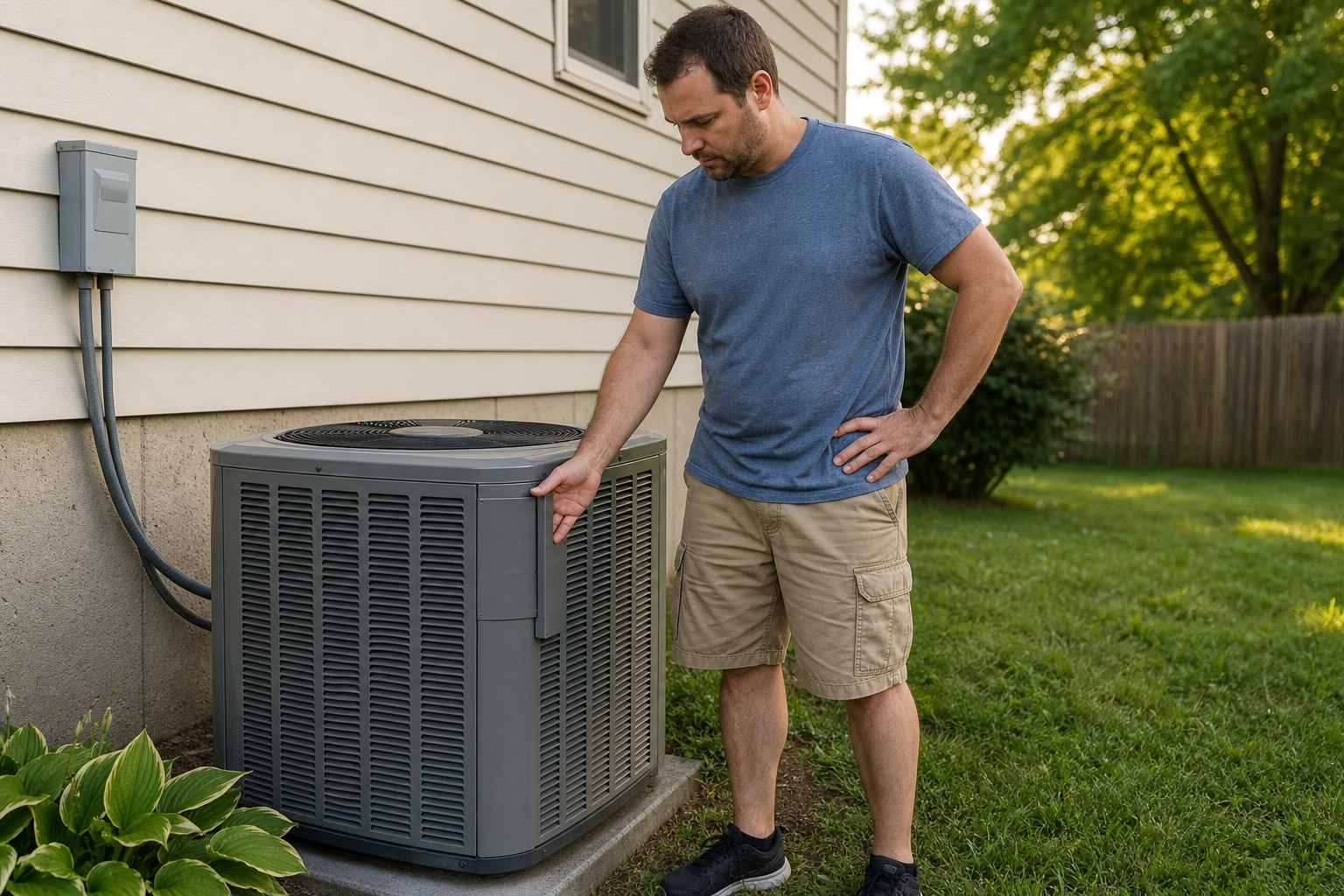
Should you turn off AC if making loud noise in St. Louis? If you’ve ever asked yourself this, the short answer is yes. If your unit is making a sound you have never heard it make before, shut it down at the thermostat and call someone. Banging, screeching, hissing, anything paired with a smell. Off. Now.
Here’s the part most blogs skip. Not every weird sound is a five-alarm fire. A click at start-up is fine. A low hum out at the condenser is fine. Air moving through your vents has a soft whoosh that should never stop bothering you. The actual question is which noises buy you a couple hours to wait for a tech and which ones eat your compressor while you’re sitting on hold.
Sam has been chasing strange AC sounds in homes around South County for 27 years. He can stand in your yard for ten seconds and tell you if it’s a 90-minute capacitor job or a unit on its last legs. If your AC is making a sound that does not feel right, do not Google it for an hour. Get a tech out to listen in person. A small problem you catch tonight is a cheap problem. The same problem next week is not.
Here’s everything you need to know about whether to turn off an AC making loud noise:
- The four sounds that mean shut it off this second
- The sounds that are safe to run until a tech arrives
- How to tell a fan-blade bang from a compressor knock
- Why a screech means motor bearings, not a “lubrication” fix
- What a hiss tells you about refrigerant and EPA rules
- The field test that tells you which buzzing is which
The Sounds That Mean Turn It Off Right Now
A handful of sounds mean stop the system this second and call somebody. Not in the morning. Not after dinner. Now. The unit is telling you something inside is grinding, leaking, or arcing, and another five minutes of run time can cost you the whole compressor.
Loud banging or clanking. Something inside the unit broke loose. Most of the time it’s a connecting rod inside the compressor or a fan blade that snapped off its mount. Every revolution the loose piece is hammering other metal parts. Run it ten more minutes and you can shred the compressor windings. That repair bill is not in the same zip code as a normal fix.
Screeching or metal-on-metal grinding. Bearings inside a motor are failing. Could be the outdoor fan motor, could be the indoor blower. Either way, friction is heating up the windings. Keep running and you cook the motor, then sometimes the wiring above it. Shut it down.
Hissing paired with a sweet smell. Refrigerant is venting somewhere in the line set or coil. This is an EPA Section 608 violation if you keep running the system on a known leak, and it also means the compressor is about to start running dry. Compressors die fast without refrigerant.
Loud electrical buzzing with a burnt smell. Something is arcing inside the disconnect or contactor. That is a real fire risk, especially in older South County homes with original electrical panels. Flip the disconnect outside, kill the breaker, and wait for a pro.
If you are hearing any of these four right now, go shut the system off at the thermostat. Do not wait to finish reading this.
The Sounds You Can Run Until the Technician Arrives
Some noises sound weird but the unit is still safe to run for a few hours while you wait for a service slot. Here’s the short list of what gets a phone call, not a shutoff.
Light rattle on startup that stops after a few seconds. Almost always a loose screw on the access panel or a stray leaf that worked its way into the fan grille. Annoying. Not destructive. Keep running and tell the tech where it’s coming from.
A low hum at the outdoor unit. A capacitor that’s getting weak makes a low hum even when the fan is spinning fine. Unit still cools. The capacitor will probably fail inside a week or two. Catch it before the compressor strains itself trying to start and the bill stays small.
Clicking from the thermostat or air handler when cycles change. That’s just relays doing their job. If the clicking lines up with the cool kicking on and off, you’re fine.
A soft whistle by a return vent. Air is squeezing past a filter that’s sitting crooked or a return that was undersized when the house got built. Pop the filter out. Check the arrow. Reseat it. The whistle should drop or vanish.
Gurgle at the indoor coil right after shut-off. Refrigerant equalizing pressure in the lines for 30 to 60 seconds after the system turns off. Totally normal. If the gurgle keeps going for whole minutes or shows up while the system is running, that’s something else and we need to look at it.
When you’re not sure, ask one question. Is the sound holding steady or getting worse by the hour? Holding steady. Fine, wait a few hours. Getting worse. Shut it down.
Banging or Clanking — A Loose Internal Part
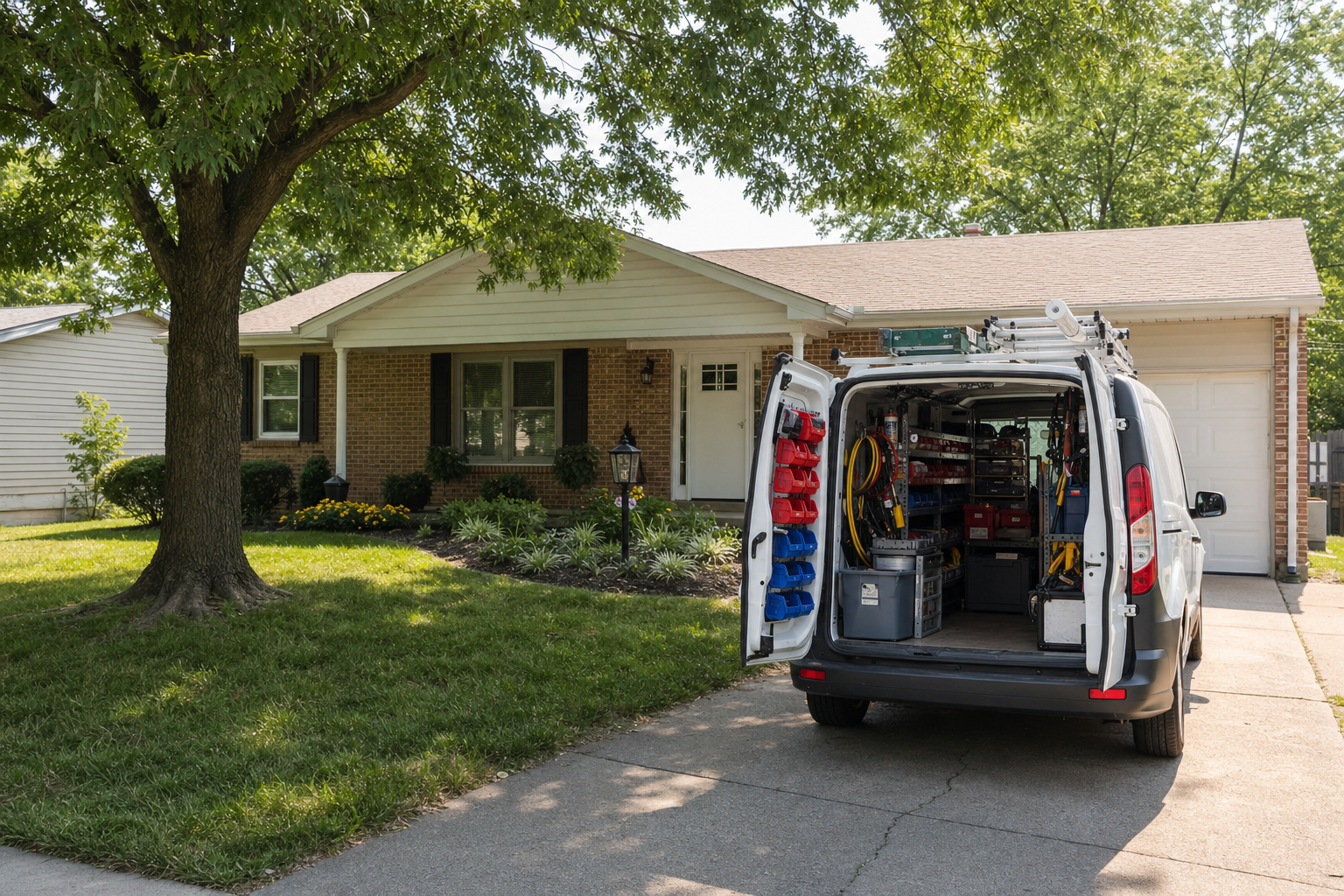
Of every emergency-sounding noise an AC makes, banging is the one homeowners most often try to ignore. Don’t. A banging sound is a piece of metal hammering other metal inside a sealed unit. Whether it’s the compressor or the fan, you have minutes, not hours, before the damage spreads.
Inside the compressor. Compressors have a connecting rod that pumps refrigerant through the system. When the rod, a piston, or a valve breaks loose, you hear a dull metallic thump every revolution. The unit will still run for a few minutes, but each pump cycle is now grinding shrapnel through the internal windings. Run it long enough and the compressor seizes. Replacing a compressor in a 6-year-old condenser usually costs more than the unit is worth, so most folks end up replacing the whole condenser instead of just the part. People who catch this on day one swap the part. People who let it ride lose the whole unit.
Outdoor fan blade. The fan blade on top of your condenser sits on a single nut. After ten years of summer cycling and Missouri storms, that nut can back off. The blade tilts and starts clipping the metal grille on every spin. That’s the loud whapping you hear. Fix is a 30-minute job. Ignore it and the blade can snap, fly off, and put a hole in the coil. Now you’re replacing a coil and a fan motor instead of tightening a nut.
The field test for which one is happening. Walk to the outdoor unit. Is the noise coming from up top where the fan spins, or from low and inside the housing where the compressor sits? Top means fan. Low and muffled means compressor. Either way, kill the disconnect outside the unit and wait for a tech.
If a banging sound is happening at your place right now, the smart move is to get a tech on the line today rather than hoping it works itself out.
Grinding or Screeching — Bearing or Motor Failure
A grinding or screeching sound means a motor’s bearings have lost their lubrication, and the metal shaft is now spinning directly against the bearing race. Friction goes up fast. Heat goes up faster. Eventually the motor’s windings overheat and short. Catch this one early and it’s a motor swap. Catch it late and the wiring can melt back into the disconnect.
Two motors on a residential AC can do this. The outdoor fan motor sits up top in the condenser. The indoor blower motor sits in the air handler in your basement or closet. Both use sealed bearings that, in theory, never need service. In reality, after 8 to 12 years of running through Missouri summers, they dry out.
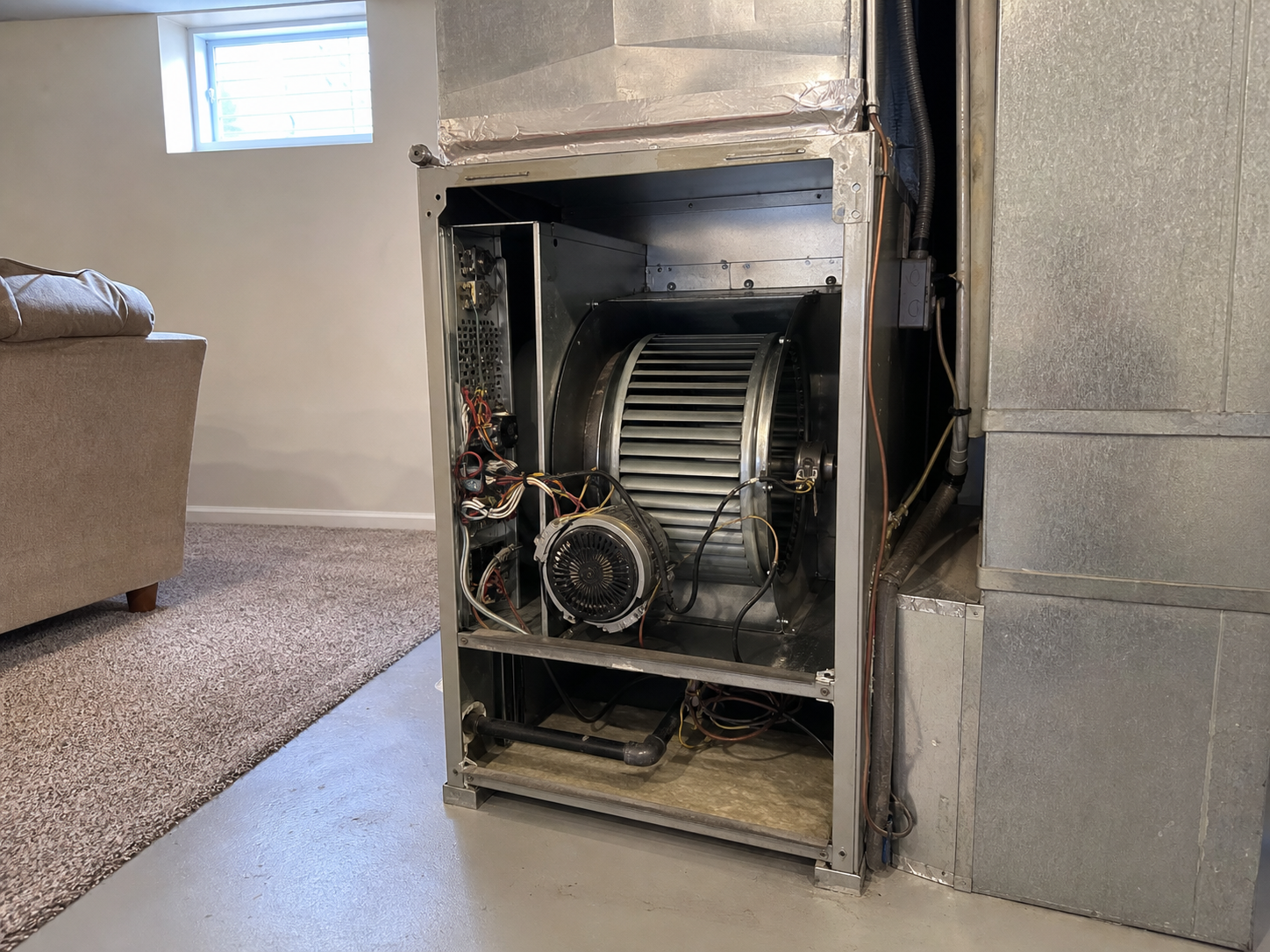
How to tell which one is screaming. Stand by the indoor unit. Loud? Indoor blower. Walk outside and stand by the condenser. Loud? Outdoor fan motor. Loud at both? Probably the outdoor unit, traveling up through the line set.
Here’s the part most companies will not say out loud. A “screeching” outdoor unit is not always a bad motor. It can be a fan blade rubbing the housing because the mount tilted. Or a piece of trim that came loose and is dragging on the spinning blade. That’s why a phone diagnosis is worth nothing for noise calls. We have to be on site, hands on the unit, before quoting you anything.
Whichever motor it is, the second you hear that screech, shut the unit off. Running it another hour, hoping it goes away, is how a small motor swap becomes a bigger motor-and-wiring repair. Worse, the windings can short to the housing, and now you have a fire risk in the condenser.
Hissing or Bubbling — Refrigerant Leak in Progress
A hiss or a bubbling sound coming off the line set or the indoor coil means refrigerant is escaping. Not a maybe. Refrigerant under pressure has nowhere else to make that noise. The system will keep running for a while, but it’s cooling less every hour, and the compressor is starting to run with thinning refrigerant. Compressors that run dry burn out fast.
There’s also a legal angle most homeowners don’t know about. EPA Section 608 makes it a violation for a licensed contractor to keep operating a system on a known refrigerant leak without repairing it or documenting why repair is not feasible. If you’ve called someone, they told you there’s a leak, and they suggested you just “top it off and see,” that’s a violation. It’s also a tell that you should call someone else.
Where the hiss usually comes from. The copper line set between the indoor and outdoor units, especially at the brazed joints. The indoor evaporator coil, where corrosion can pinhole the aluminum fins. The Schrader valves at the service ports. Any of these need to be found with electronic leak detection or UV dye, not by ear.
What to do right now. Shut the system off at the thermostat. Do not run it in “fan only” hoping to thaw an iced coil. If the leak is bad enough to hear, the coil will frost over within an hour. Frost on the indoor coil restricts airflow, which makes the system trip safety controls, which makes the compressor start short-cycling. Short-cycling kills compressors.
A leaking system is not the same as a low-charge system. Low charge means somebody under-filled it years ago. Leaking means there’s a hole. The first one tops off and lasts seasons. The second one tops off and is empty again next month. Make sure the tech tells you which one you have.
Buzzing or Humming — Electrical or Capacitor Issue
Buzzing is the trickiest sound to diagnose by ear because there are at least three different things that can make it. A weak capacitor. A failing contactor. An arcing wire inside the disconnect. All three sound similar from ten feet away, but only one of them is safe to leave running while you wait for a tech.
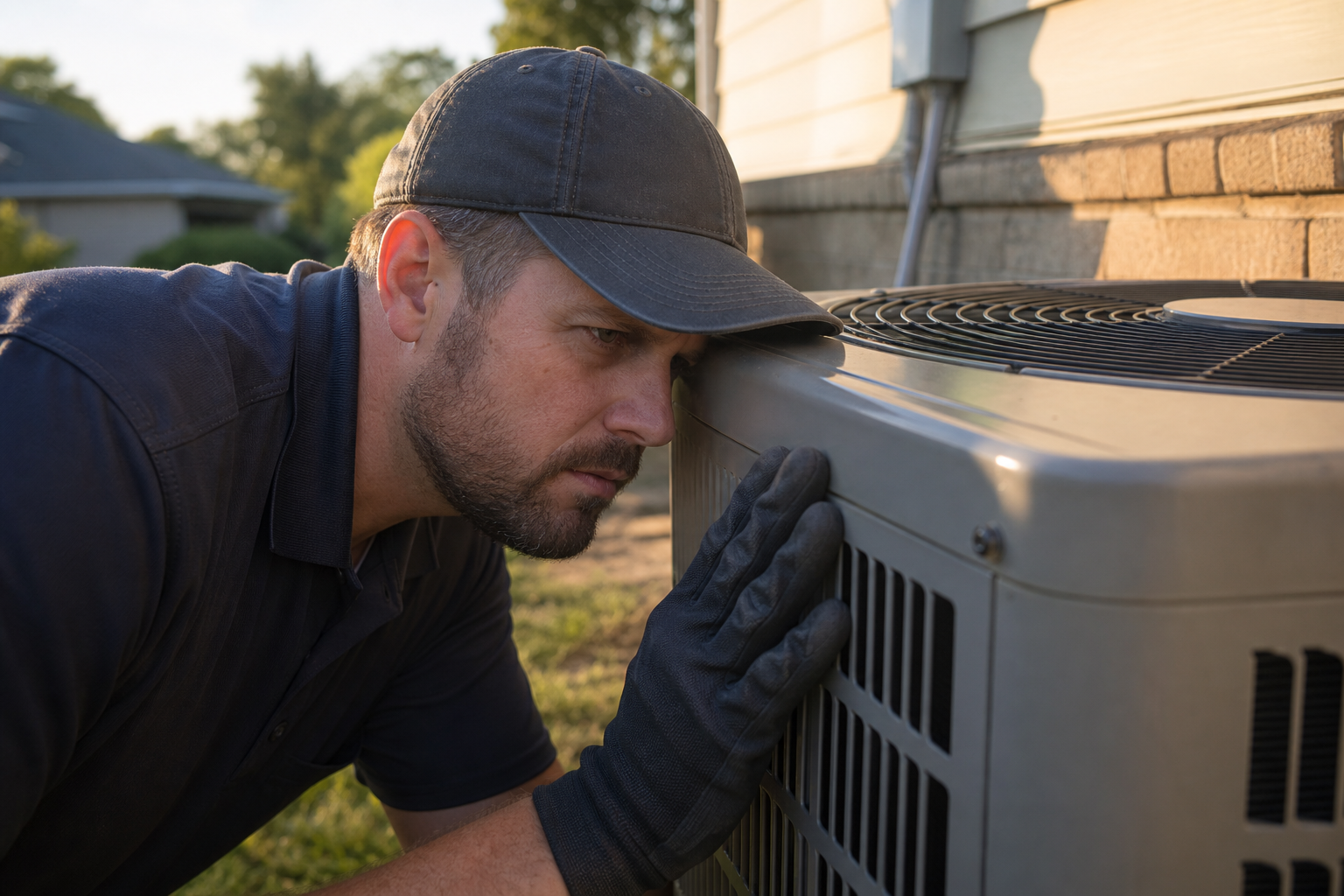
Here’s the homeowner field test. Set your thermostat to “off” and stand by the outdoor unit. Does the buzz stop? If yes, the noise is tied to the system trying to run, and you’re probably looking at a weak capacitor or contactor. Not safe to keep cycling, but not an active fire risk. Schedule a same-day call and leave it off until they arrive.
Does the buzz keep going with the thermostat off? Now you have a problem. Something is energized when nothing should be, and that’s either a contactor that’s welded itself shut or a wire arcing in the disconnect. Walk to the disconnect box mounted on the wall next to your condenser, flip it to the off position, and then go kill the breaker in the panel. Wait for a pro. Do not poke at the disconnect with the power live.
The capacitor angle, since it’s the most common cause we see in South County homes. Capacitors store the jolt that kicks the motor into spin. A weak one whines. A failed one is silent and the unit just sits there humming, never starting. If you hear a humming unit that won’t spin up, kill power to it. Running a motor that can’t start is how the windings burn out, and that turns a 20-minute capacitor swap into an entirely different conversation.
Buzzing is one of those sounds where the diagnosis tools matter. A clamp meter on the capacitor reads in 30 seconds. Guessing by ear costs you the wrong part and another visit.
Why St. Louis Homeowners Trust Liberty to Diagnose AC Noises
Diagnosing noises is one of those skills that does not get taught in school. You learn it by standing in front of thousands of units across a couple decades and matching what you hear to what you find when you open the housing. Sam has been doing exactly that across South County and the Metro East for 27 years now.
That track record matters here because noise diagnosis is where shortcut contractors lose homeowners money. The phone tech who says “sounds like a capacitor, we’ll bring one” without listening to the unit is guessing. Half the time the part is right, the other half it’s a wasted truck roll plus a return visit. We don’t run that way. The tech is on site, hands on the unit, before any part gets ordered or any quote gets written.
Liberty is family owned, fully licensed, bonded, and insured. We answer the phone seven days a week including weekends and holidays, because no one’s compressor blows itself out on a 9-to-5 schedule. Senior citizens get a 10 percent discount applied to the ticket. Same-day diagnostic slots are open across Oakville, Mehlville, the Lemay corridor, and into the Metro East side of the river.
We’ve heard pretty much every noise an AC can make. The clanking that turned out to be a piece of squirrel debris in the fan grille. The “screech” that was actually a contractor sticker that came loose and was hitting the blade. The “compressor knock” that was a homeowner’s outdoor cabinet door bouncing against the unit in the wind. Knowing what each sound actually is, vs. what it sounds like, is what we get paid for.
If your AC is making a sound that doesn’t sit right, the smartest play is to have someone listen who’s heard it all before.
Hearing Something That Shouldn’t Be Coming Out of Your AC? Call Today
Standing in the kitchen, talking yourself into “maybe it’ll just stop on its own,” is how every bad outcome starts. Your ear caught the sound for a reason. The unit was quiet last week and it’s not quiet now. That’s all the diagnosis you need to make the call. Catching a sound early means the bill stays small. Waiting it out means the bill stops being small.
Want a little context on what a residential cooling system should sound and feel like when it’s healthy? The U.S. Department of Energy’s plain-English home cooling systems guide is a quick read. Won’t fix anything tonight. Does help you tell normal from “uh oh” next time around.
Call Liberty Heating Cooling & Plumbing at (314) 600-2202 or schedule online. We’re available seven days a week including weekends and holidays. Same-day AC diagnostics available throughout Oakville and South St. Louis County.