Serving St. Louis & Surrounding Areas

What Should You Do If Your AC Suddenly Stops Working in St. Louis?
What to do if AC suddenly stops working in St. Louis on a 95-degree afternoon comes down to a fast triage, not a long article. Walk to the thermostat, check both breakers in the panel, look at the outdoor condenser, and find the basement float switch. Most sudden cutouts trace to a tripped safety, not a dead compressor.
A sudden cutout in the middle of a heat wave is different from an AC that has been weak for a week. Sudden means power, controls, or a tripped safety nine times out of ten. Most of those are homeowner-fixable. The other one in ten is a part that just gave up, and that part is not coming back without a tech and a truck. Either way, knowing which bucket you are in inside the first ten minutes is the whole game.
We are Liberty Heating Cooling & Plumbing in Oakville, MO. Sam has been answering “my AC just died” calls in South County for 27 years and would rather walk you through the quick checks first than charge for a flipped breaker. If the triage below comes up dry and the indoor temp is already climbing past the comfort zone, that is the point where you want to get a technician out the same day.
Here’s everything you need to know about what to do if AC suddenly stops working in St. Louis:
- Triage first. Thermostat, both breakers, outdoor unit, float switch. Ten minutes, no tools.
- The vulnerable people in the house move the clock faster than the outdoor temp does.
- A heat-wave cutout almost always traces to a tripped safety, not a dead compressor.
- Both breakers matter. AC has two in most homes, and most folks only know about one.
- The basement float switch is the one nobody warns you about.
- If triage fails and indoor temp is climbing, that is the same-day-call line.
The 30-Second Triage Before You Pick Up the Phone
Before you grab the phone, give yourself ten minutes and four stops in order: thermostat, breaker panel, outdoor condenser, then the indoor unit in the basement. Free to do, no tools needed, and any one of them might be the whole answer.
The order matters because most sudden cutouts are stuck somewhere upstream of the actual cooling parts. A bumped thermostat blocks the call before it ever leaves the wall. A tripped breaker kills the signal halfway there. A clogged drain trips the kill switch on the indoor side. Walk the path the call has to take and you usually find the snag.
Here is the thing folks miss about sudden failures versus slow ones. When an AC dies all at once on a 95-degree day, it almost never traces back to a slow-failing part that finally gave up. It traces to a safety doing exactly what it was built to do. Slow failures show up as weak cooling for a week. Hard cutouts on a hot afternoon mean the system pulled its own plug, and you can usually unplug whatever spooked it in a few minutes flat.
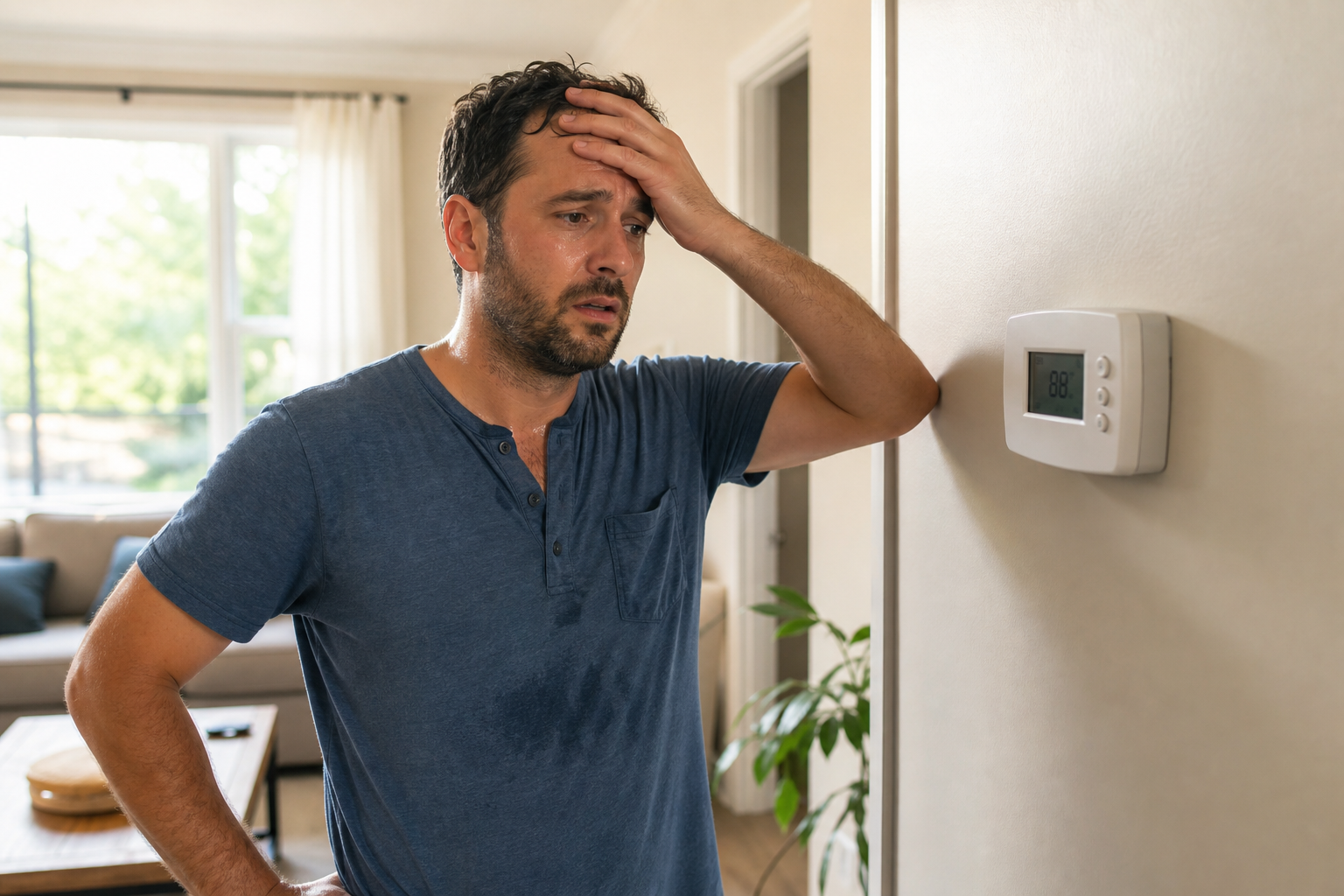
Check the Thermostat First (Yes, It Embarrasses People)
Skip this step at your own risk. Around a third of the “my AC just died” calls Sam takes end at the thermostat. Mode switched to FAN by a kid. Schedule override from a smart-home app. Dead batteries in a unit nobody knew had batteries.
Pop the cover off the thermostat. Most residential models take two AA batteries even if the unit is hardwired. A dying battery leaves the display alive enough to look normal but kills the relay signal that fires the equipment. Swap the batteries first, then set the mode to COOL, then drop the set point well below the room reading.
Smart thermostats add a second trap. Open the app on your phone and see what mode is actually active. An “eco” override, a vacation hold, or a software update that reset preferences can all leave the home thermostat displaying one thing while the system is following a different rule. Force cool from the app. If the system kicks on, you found your answer and you can move on with your day.
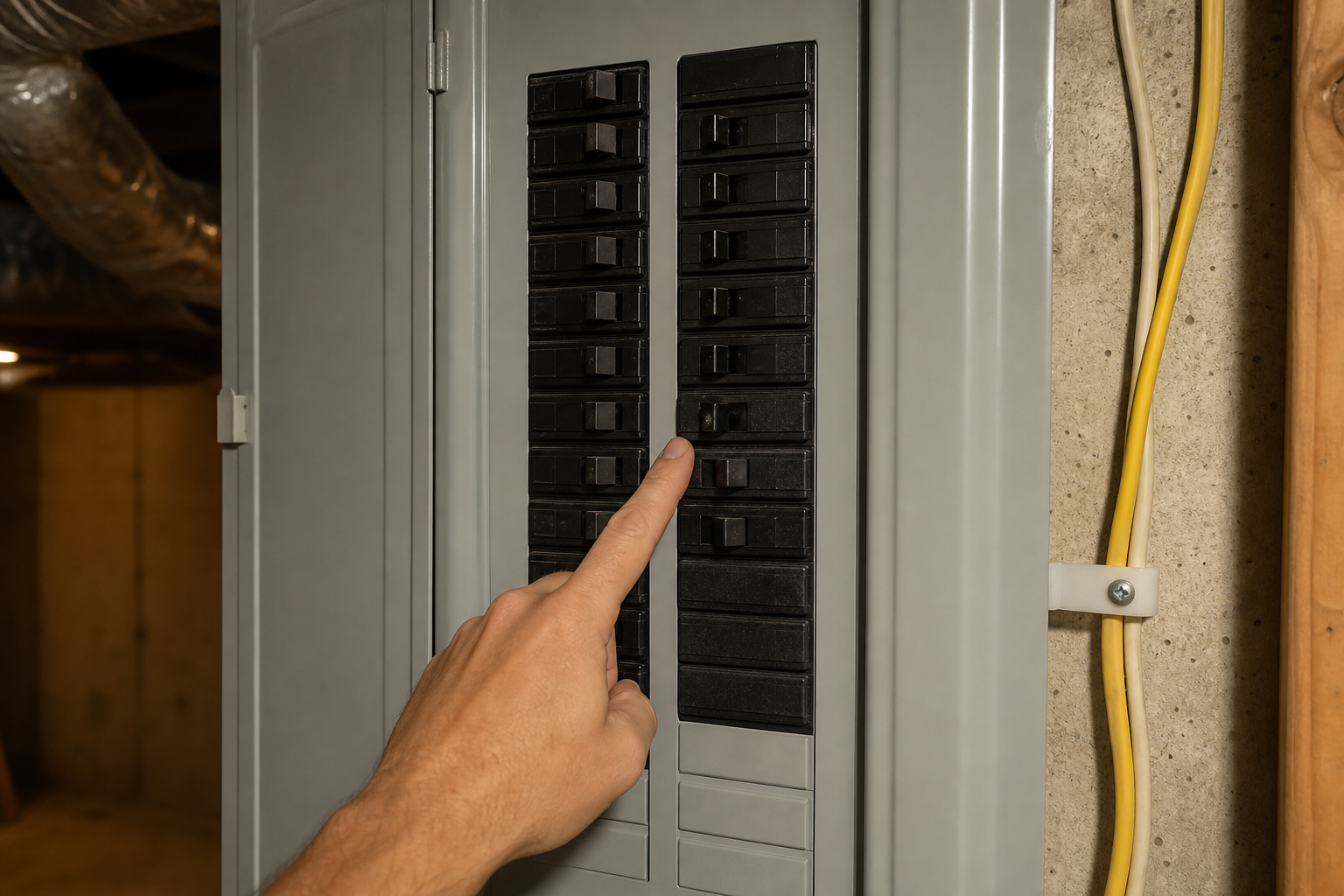
Check Both Breakers, Not Just the One You Know About
This one trips people up every summer. A central AC in a South County home almost always has two breakers in the panel, not one. The indoor blower runs off one. The outdoor condenser runs off a separate, larger one. If either trips, the system cuts out, and depending on which side flipped, you might get no air at all or just no cooling.
Open the panel cover and scan every breaker top to bottom. A tripped breaker usually sits a hair off-center, stuck between ON and OFF. Push it firmly all the way to OFF, then back to ON until you feel it click. If it trips again immediately, walk away. That is the system telling you there is a short or an overload, and resetting it repeatedly is a great way to cook something expensive.
Older homes around Mehlville and the South County corridor sometimes use a fuse for the AC instead of a breaker. The fuse box bolts to the wall right next to the outdoor unit. A blown fuse looks discolored, sometimes cracked, sometimes outright burnt. Swapping one is doable if you know the amperage and you are comfortable around live voltage. If you are not, leave it for a tech wearing the right gloves.
Walk to the Outdoor Unit and Listen
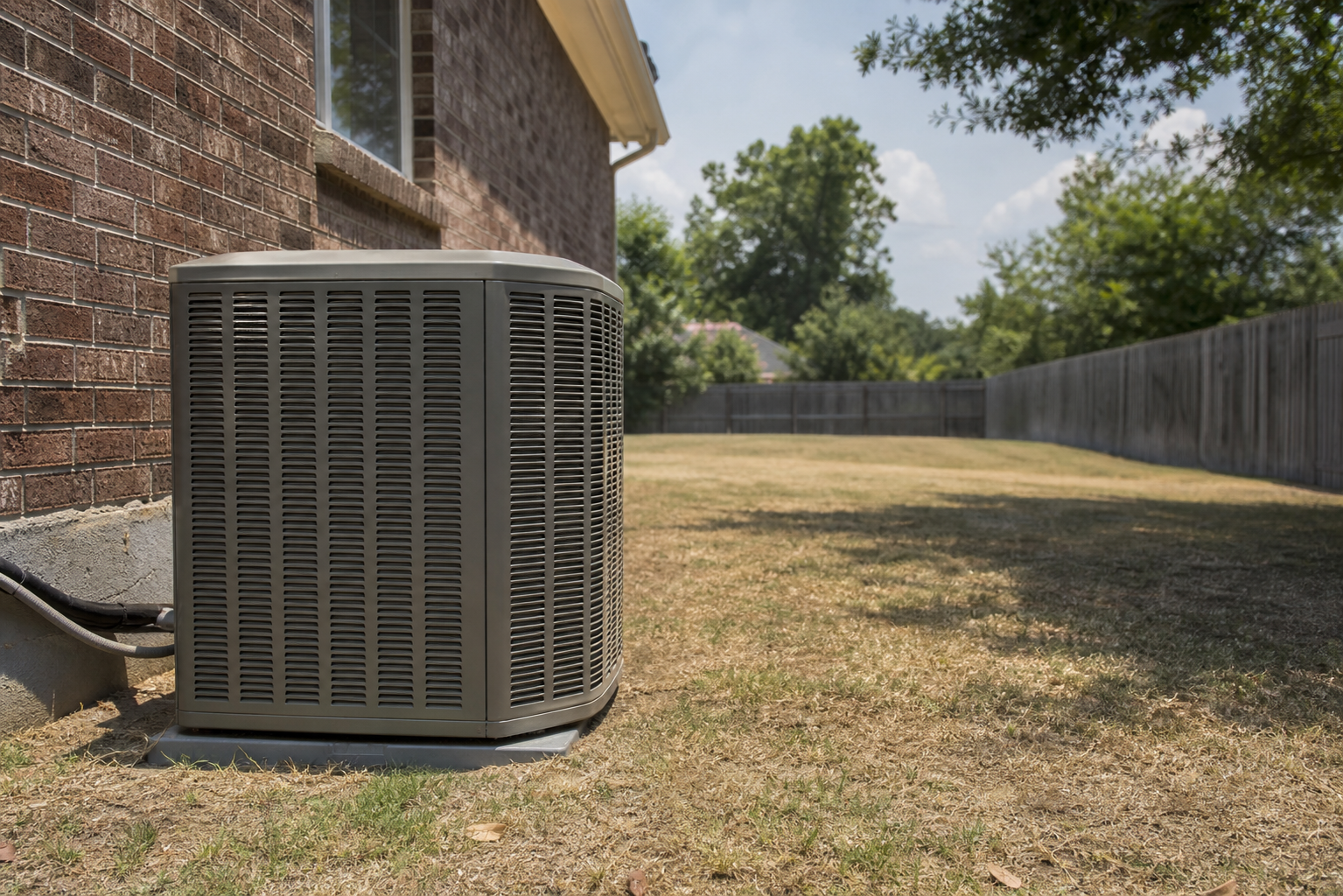
Stand next to the condenser for thirty seconds with the system calling for cool. You are listening for one of three patterns, and each one tells you something different.
Pattern one is dead silence: no fan spin, no humming, no clicking. That points right back to power, which means the disconnect, the breaker, or the fuse. Recheck the panel and the pull-out box on the wall next to the condenser, because a lawn mower or yard tool can knock that handle loose without you noticing.
Pattern two is humming with no fan spin. The compressor or fan motor is getting power but cannot start. That is usually a failed capacitor, which is a small part inside the unit that holds a starting charge. A capacitor is a real repair, not a DIY job, because the part can shock you even with the power off. Kill power at the disconnect to protect the compressor and call for a same-day diagnostic.
Pattern three is ice on the copper lines or on the unit body itself. That is either an airflow problem from a clogged filter or a refrigerant issue. Shut the system off, let it thaw fully, and if it ices again after a clean filter and a few hours of thaw time, you have something worth booking a diagnostic for. Running an iced system on a hot day will eventually take the compressor with it.
The Float Switch in Your Basement You Probably Don’t Know About
This is the check nobody tells you about, and it shuts down healthy systems on a regular basis. Most homes in the area have the indoor air handler in the basement. Look at the base of the unit. You are hunting for a small white plastic pan, or a PVC pipe coming off the indoor coil.
Tucked along that drain path is a float switch. When the condensate line clogs with algae or basement dust, water has nowhere to drain, the float rides up, and the system kills cooling on purpose so your basement does not flood. From your end, it looks identical to a dead AC. Indoor blower may still run, but no cool air, no outdoor unit firing.
Look for standing water in the pan or a damp ring of insulation under the air handler. If you see either, grab a wet-dry shop vac, walk outside, and put the hose on the open end of the condensate line where it pokes out of the wall. Run it for five minutes. The clog usually rips loose, water comes out the other side, the float drops, and the AC fires back up within a couple of minutes. Older homes around here are famous for this exact problem, and most folks never even know the switch is there until somebody points it out.
When the Triage Comes Up Empty, These Triggers Earn a Same-Day Call
Sometimes you run every check and the house keeps heating up anyway. Honest answer from the field: the equipment is only half the question. The other half is who is in the room and what tomorrow’s weather looks like. Here is when Sam tells homeowners not to wait.
Look at who is in the house with you first: a baby under one, a parent in their late seventies, anyone with a heart issue, asthma, or kidney trouble, or anyone on a med like a beta blocker or diuretic that throws off how their body cools itself. With a couple of healthy adults inside, 82 degrees indoor is just sticky. With a six-month-old napping in the back room, or grandma on the couch, 82 indoor stops being a comfort question. It is a safety call now, and the visit gets booked today.
The forecast counts almost as much as the room temp. If the AC quit at three in the afternoon on a 95-degree day and the news is calling for another 95 tomorrow, the house has zero chance to dump its heat overnight. Drywall, flooring, and even the couch all keep soaking up warmth, and with overnight lows stuck above 75, a closed-up house drifts five to eight degrees warmer by dawn. You wake up further behind than you went to bed, and that gap never closes during the next afternoon. Heat waves pile on top of each other, that simply.
Then there is the third bucket, and this one is non-negotiable. If you smelled something burnt off the indoor vent, heard a loud bang or grinding from outside right before it died, saw smoke, or noticed scorch marks at the disconnect, do not run the checklist. Flip the breaker off, leave it alone, and call. That is not a homeowner repair anymore. That is a pro-only situation, and the longer it sits with the breaker on, the worse the next bill gets.
Why South County Homeowners Trust Liberty With Sudden AC Failure Calls
Sam has been answering “my AC just died” calls in this corner of the metro for 27 years and the reason Liberty publishes a checklist like this one is simple. He would rather you save yourself a service call on a flipped breaker than feel taken advantage of when the bill shows up for a five-minute fix. The homes around here all have their patterns: older basements with float switches that nobody knew existed, two-breaker panels that confuse newer owners, and outdoor disconnects sitting at lawn-mower height. Sam has seen all of it.
Liberty is family-owned, licensed, bonded, and insured. There is a 10% discount for seniors. We are available seven days a week including weekends and holidays, and same-day service is the norm, not the exception during peak summer. When the triage above does not bring the cool air back, the diagnostic on the next visit is methodical, not a parts-swap guessing game. You get told what is actually wrong, what it costs to fix, and whether the system is even worth fixing given its age.
If you ran the triage, struck out, and the house is heating up faster than people in it can handle, that is the moment to book an emergency visit with our team. We will be out same day in almost every case.
Ran the Checklist and Still Hot? Here’s How to Get a Technician Out Today
Worked through the triage and the system still will not fire. Or the indoor temp is climbing past what the people in your house can safely handle. Either of those is the line where waiting stops making sense. The usual suspects from this point on are a failed capacitor, a contactor that will not pull in, a refrigerant charge that finally dropped below the cutoff, or a compressor at the end of its run. Each one is a different fix and each one needs gauges and a meter, not a flashlight.
If you want a bit more reading on how central cooling works before the tech shows up, the Department of Energy’s home cooling systems guide is a ten-minute read with no jargon. Worth it if you want to follow along when the diagnostic happens.
When the triage runs out and you need real hands on the system, call Liberty Heating Cooling & Plumbing at (314) 600-2202 or book online. Seven days a week, weekends and holidays included. Same-day service across Oakville and South St. Louis County, plus the Metro East side over in Monroe County IL.