Serving St. Louis & Surrounding Areas

Boiler Repair in Oakville, MO: Diagnosed by Component
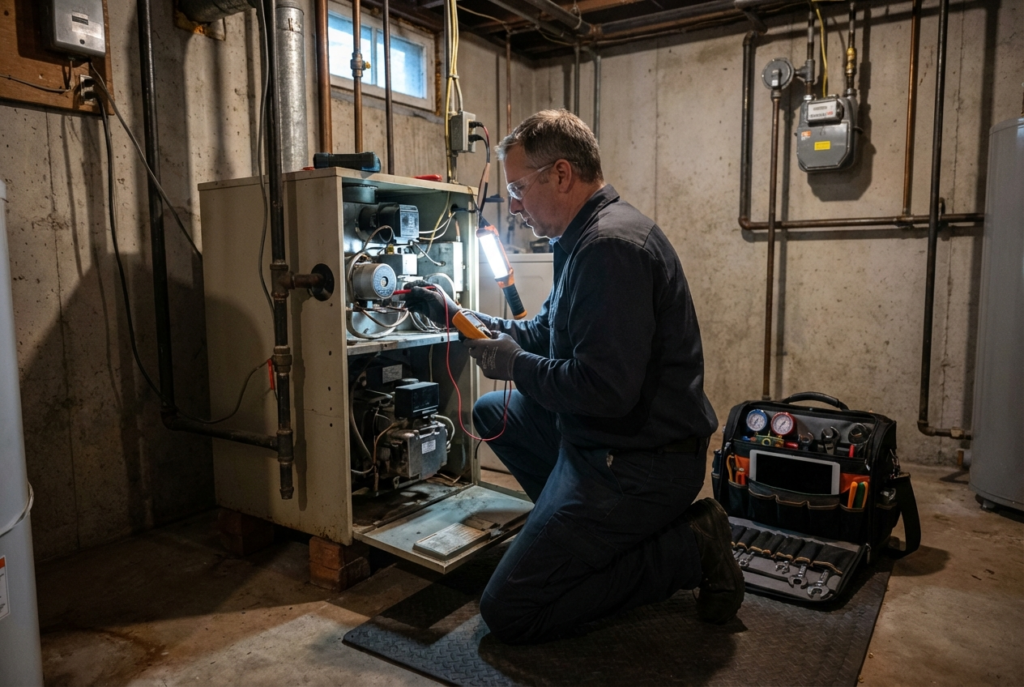
A boiler and a furnace solve the same problem with almost nothing in common. A furnace heats air and blows it down ducts. A boiler heats water and pushes it through pipes to radiators or floor loops, and the water is the whole system. There is no blower, no filter, no duct. So when a boiler misbehaves, the useful question is not what the symptom is but which component is responsible, and that is how this page is laid out.
The Circulator Pump
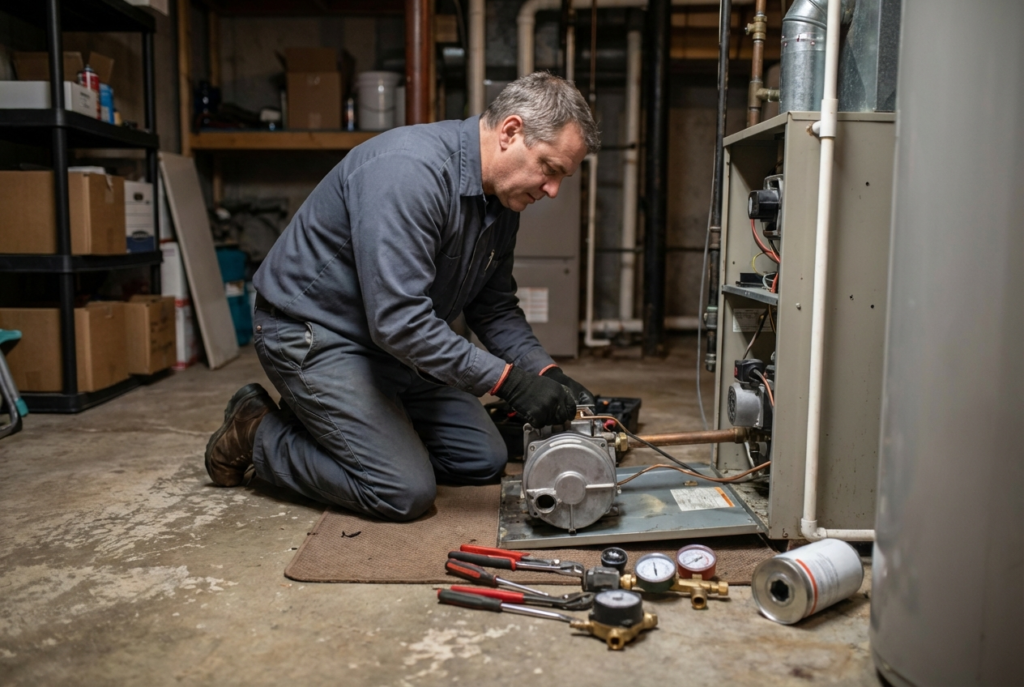
The circulator is the part that makes a boiler a heating system rather than a large hot kettle in the basement. It pushes heated water out to the radiators and pulls cooled water back.
Its failure has an unmistakable signature. The boiler fires normally, the pipe leaving it gets hot, and the radiators stay cold. Everything sounds correct and nothing arrives. People often assume the boiler has failed when the boiler is the one part working properly.
Most circulators fail in one of three ways. The bearings go, which announces itself as a grinding or humming that gets worse over weeks. The motor gives up entirely and it goes silent. Or the impeller, the small wheel actually moving the water, breaks or comes loose from its shaft, which is the deceptive one because the motor still runs and sounds healthy while moving nothing at all.
On systems with several loops there may be more than one circulator, which is why part of a house can go cold while the rest is fine. That symptom overlaps with zone valve trouble, and telling the two apart is a matter of checking which components are actually being energized when a thermostat calls.
System Pressure, the Gauge, and the Expansion Tank
Every boiler has a gauge, and it is the single most useful thing in the room. On a typical residential system the needle should sit around twelve to fifteen pounds when the water is cold, and rise modestly when the system is hot. Both directions away from that tell you something specific.
Pressure that drifts down over days means water is leaving somewhere. It can be a weeping fitting, a pinhole in buried pipe, or a relief valve that is not seating properly. A system topping itself up through an automatic fill valve will hide a slow leak for a whole season, which is why a fill valve that runs often is worth investigating rather than ignoring.
Pressure that climbs steeply as the system heats points at the expansion tank. Water expands when it is heated and that expansion has to go somewhere. The tank gives it room by compressing a cushion of air behind a diaphragm. When the diaphragm fails, the tank fills with water, the cushion is gone, and pressure has nowhere to go but up until the relief valve opens and dumps onto the floor.
There is a quick field check for this. A healthy tank feels warm near the boiler side and noticeably cooler toward its far end. A tank that is the same temperature all over, and feels heavy, is usually waterlogged. That relief valve discharging is a symptom, and replacing the valve without finding out why it opened simply removes the alarm.
Zone Valves and the Thermostats That Drive Them
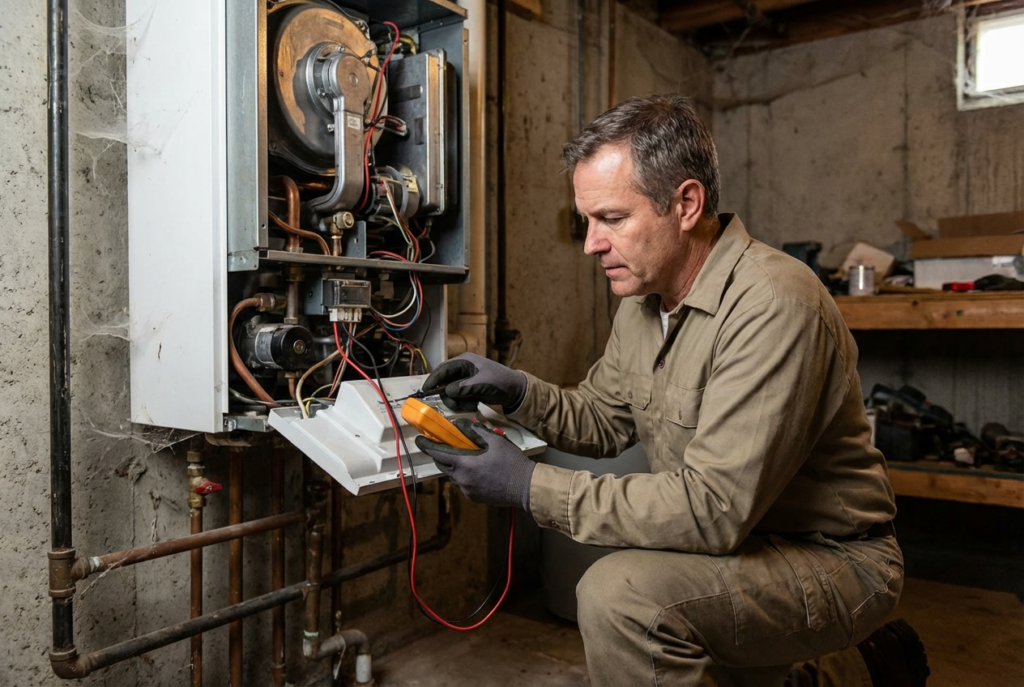
Most houses here are divided into zones, and a zone valve is the small motorized gate that opens a loop when its thermostat asks for heat. When one area of a house goes cold while everything else is comfortable, this is usually where it lives.
Zone valves fail in a way worth understanding, because it explains a confusing symptom. Inside each one is an actuator that swings the valve open and an end switch that reports back to the boiler that the valve has actually opened. Those two can fail independently. A valve that opens without reporting leaves you with a warm loop and a boiler that never fires. A valve that reports without opening gives you a boiler running steadily and one zone that stays stubbornly cold.
Some valves can be opened by hand with a small lever, which is a useful diagnostic. If forcing it open restores heat to that area, the loop and the radiators are fine and the fault is in the valve or its wiring rather than anywhere in the piping.
Thermostat trouble imitates all of this closely. A dead battery or a broken conductor in a thermostat wire produces a zone that never calls, which looks identical from the radiator’s point of view.
Air in the Lines
Air is the most common reason a single radiator stops working, and it is also the one homeowners can most often resolve without help.
Air enters constantly. Fresh water added to the system carries dissolved gases that come out of solution as it heats, and any point where the system runs below atmospheric pressure can draw air inward. Once it is in, it rises to the highest point in the piping and parks there, and a pocket of air is a wall that water will not push through.
The result is a radiator that is warm at the bottom and cold across the top, which is the classic signature. Upper floors go first because air rises. Bleeding the radiator with a key at its bleed valve, until liquid rather than hissing comes out, usually restores it.
Air is also what does most of the banging. Water arriving into a pocket of trapped air, or slamming to a stop when a valve closes quickly, produces the knock that sounds like somebody striking the pipe. Straps that have loosened let the pipe move and amplify it.
Bleeding the same radiator repeatedly is the part worth paying attention to. Air that keeps returning is being introduced by something, usually a small leak or an automatic air vent that has stopped working. Bleeding it every month means treating that symptom forever without ever reaching the cause.
Scale, Sludge, and the Water Itself
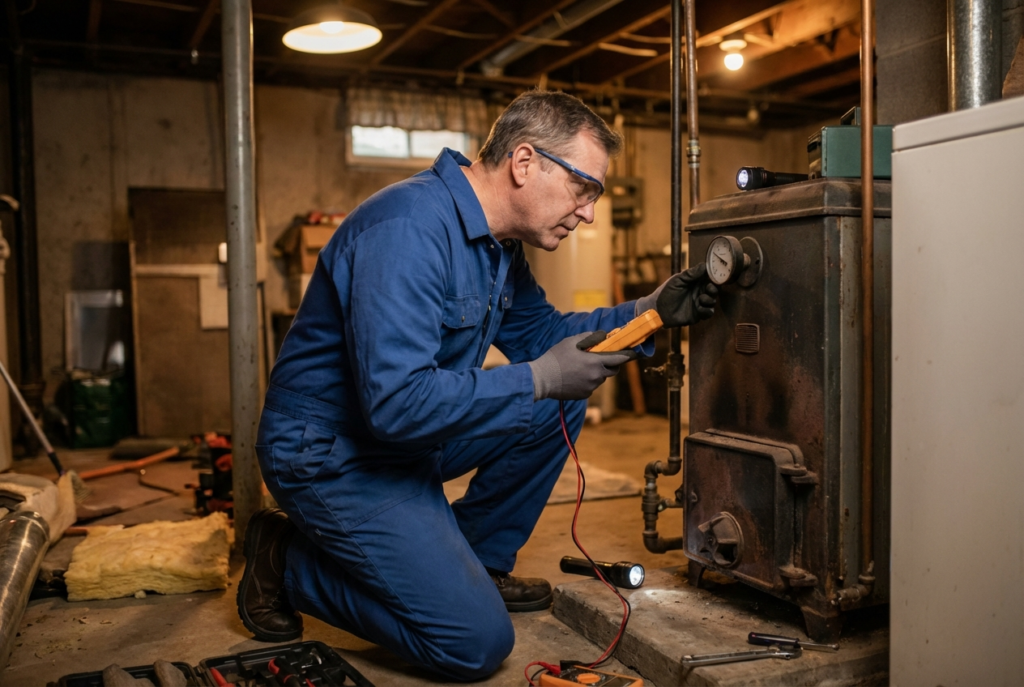
The water in a hydronic system is not scenery. It is a working component, and its condition determines how long everything else lasts.
Over years, iron oxide builds up as a fine black sludge that settles into the bottoms of radiators and the low points of pipework. Mineral scale plates onto the hottest surfaces inside the boiler. Both restrict flow, and both act as insulation in exactly the places designed to transfer heat.
Kettling is what this sounds like. When scale insulates part of the heat transfer surface, water in contact with it flashes to steam in small pockets and collapses again, and the boiler rumbles like a kettle coming to a boil. It is not cosmetic. It means part of the boiler is running far hotter than intended.
A power flush clears sludge and a descale addresses the mineral side, and adding a corrosion inhibitor afterward is what stops the process starting over. One honest warning about flushing an old system: sludge sometimes plugs pinholes that were already there, and cleaning it out can reveal leaks that were technically present for years. That is a discovery rather than damage, but it is better to hear it before rather than after.
Leaks and Where They Come From
Water on the floor is the one symptom nobody ignores, and the source is often not where the puddle is.
- Circulator flange gaskets, which sit right at the pump and weep slowly as they age
- The relief valve, which is usually discharging for a reason rather than failing on its own
- Radiator valve packings, which tend to start once a valve that has not moved in years is turned
- Threaded joints that have been through enough heating and cooling cycles to work loose
- Pinholes in buried or embedded pipe, which show as unexplained pressure loss long before they show as water
Leaks that only appear when the system is hot are common and confusing, because everything is dry when somebody comes to look at it in the morning. If that describes yours, say so when you call, because it changes how the visit is done.
When It Is the Design Rather Than a Broken Part
Sometimes every component checks out and the house still heats unevenly. That is worth naming plainly, because no repair fixes it.
Radiators sized for rooms that were later opened up or added to. Loops carrying more length than they were laid out for. Zones drawn around how a house was used decades ago rather than how it is used now. These produce a system that works exactly as built and still disappoints.
We will tell you when that is what we are looking at instead of selling you parts against it. Sometimes there is a modest fix, such as rebalancing flow between loops or correcting a zone that was wired to the wrong thermostat. Sometimes the answer is that the layout itself is the limit, and you should know that before spending anything.
Frequently Asked Questions
My boiler is running but the radiators are cold. What does that mean?
That combination almost always points at circulation rather than at the boiler. Either the circulator pump is not moving water, or a zone valve is not opening, or an air pocket is blocking the loop. The boiler doing its job while nothing gets warm is a distribution problem, not a heating one.
What should my boiler pressure gauge read?
Around twelve to fifteen pounds cold on a typical residential system, rising somewhat when hot. Drifting downward over days means water is escaping somewhere. Climbing sharply as it heats usually means the expansion tank has lost its air cushion and can no longer absorb the expansion.
Why is one radiator cold at the top and warm at the bottom?
Trapped air. It collects at the highest point it can reach and blocks water from filling the upper part of the radiator. Bleeding that radiator until liquid comes out of the bleed valve usually fixes it. If the same radiator needs bleeding repeatedly, something is letting air in and that is worth finding.
My boiler makes a rumbling sound like a kettle. Is that serious?
It is worth attending to. Kettling means mineral scale has built up on heat transfer surfaces and water is flashing to steam in the hot spots behind it. The sound is a symptom of part of the boiler running hotter than it was designed to, and it responds to descaling rather than to a replacement part.
Do you actually work on boilers, or mostly furnaces?
We work on hydronic systems regularly and stock circulators, common zone valves, relief valves and controls. Boiler models vary far more than furnaces do, so some components have to come from a supplier, and you will hear about any wait up front instead of discovering it on the invoice.
Is it worth repairing an older boiler?
Often yes, more so than with forced air equipment. Cast iron boilers routinely run for decades, and the components that fail on them, pumps, valves, tanks and controls, are replaceable parts rather than the boiler itself. The question is the condition of the vessel, not the age on the label.
Get a Boiler Person, Not a Guess
Tell us what the gauge reads, whether the pipe leaving the boiler gets hot, and which rooms are affected. Those three answers narrow it to a component before anybody opens a toolbox.
Our number is (314) 600-2202. Say boiler when somebody answers, because it changes what we bring with us. If the radiators are cold and the house is heading that way tonight, emergency boiler repair covers what is at stake and how fast. If the system is simply old and you are weighing what comes next, boiler installation is the other half of that conversation.