Serving St. Louis & Surrounding Areas
Emergency Furnace Repair in Oakville, MO: The Next Hour, in Order
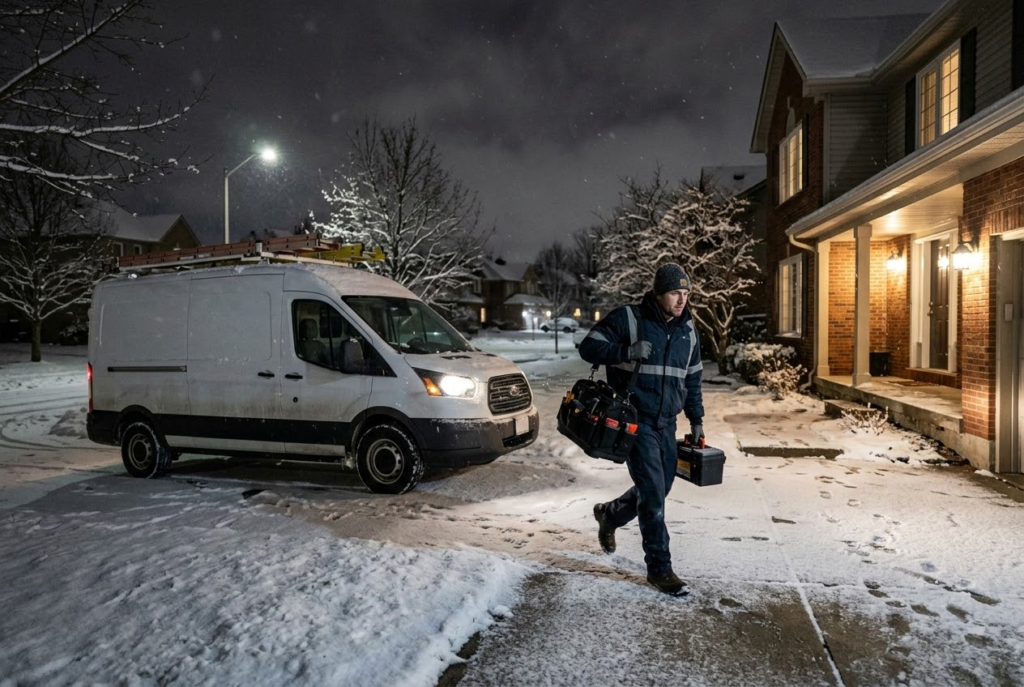
A furnace that quits at eleven at night is a different problem from one that quits on a Tuesday afternoon, and not because the failed part is any different. It is different because you are deciding tired, in the dark, with the house cooling while you decide. So this is not a list of causes. It is the next hour, in the order the hour happens.
Start With the Two Things That Are Not About Heat
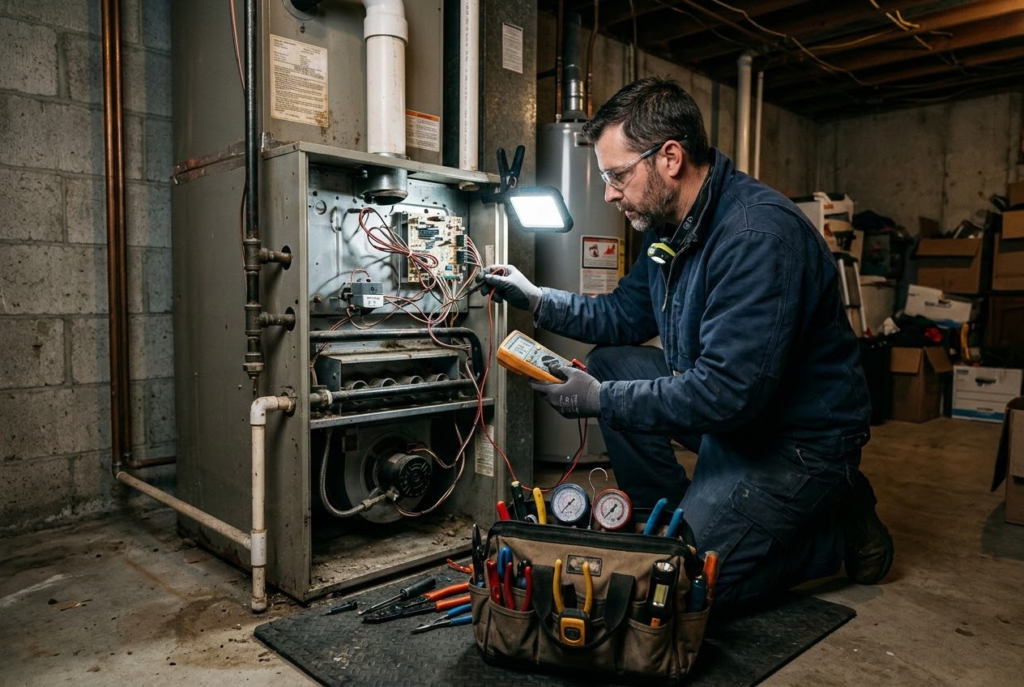
Before anybody thinks about the furnace, two situations outrank a cold house entirely.
A sounding carbon monoxide alarm means everyone goes outside, pets included, and the call gets made standing in the yard. Nobody stays behind to open windows or goes back for a phone charger. Alarms do sometimes cry wolf, but you cannot learn which kind of night this is from inside the building, and the fire department will come and tell you at no charge.
A basement that smells like sulfur or rotten eggs gets the same treatment. Leave without touching a light switch, the garage door button, or anything else that makes a spark, then call the gas utility on the emergency number printed on your bill. They come out at any hour at no cost. We are not permitted to touch that furnace until they have made the property safe, so calling them first is the faster road back to heat.
If neither is happening, what you have is a cold house and a night to get through. That is an inconvenience with a deadline attached, and the rest of this page is about the deadline.
One Reset, Not Five
Nearly every furnace built in the last twenty five years keeps count of its own failures. When the ignition sequence fails a set number of times in a row, usually three, the control board quits trying and drops into lockout. It sits there doing nothing at all, even if whatever caused those failures has since cleared itself.
Killing power at the breaker for a minute and switching it back on wipes that count and buys one honest attempt. Do it once. If it lights and stays lit, you have bought the night and turned this into a daytime service call. If it locks out again, the count was never the problem, and repeating the reset only piles more ignition cycles onto a part that is already dying.
If you have not been through the free checks yet, they are written out on our furnace repair page and take about two minutes. A fair share of after dark calls end right there, and we would rather you find it than pay somebody to point at it.
Half an Hour Tells You More Than the Thermostat Does
The number on the wall right now is close to meaningless on its own. What decides your night is how fast it is moving. Write it down, wait thirty minutes, write it down again.
A house shedding about a degree an hour with an overnight low in the twenties finishes the night somewhere in the fifties. Cold, miserable, safe. Four or five degrees an hour is a different night, and that rate usually means the building is leaking heat badly, or the temperature outside is still falling, or both.
Then three questions about the house rather than the furnace.
- Who is sleeping here. Infants, anyone in their late seventies or beyond, anyone on oxygen or living with a heart or circulation condition, and anyone recovering from surgery all lose the ability to ride out a cold night a healthy adult barely registers.
- Where the plumbing runs. Water lines in an exterior wall, a crawl space, an unheated garage or a slab addition give out first, well before the living room becomes unbearable.
- Whether a second source of heat genuinely works. A usable fireplace, gas logs, or a heat pump that still runs on its own changes the arithmetic.
Have those three answers and the rate in front of you before you dial.
What to Say When Somebody Picks Up
The first ninety seconds of that call decide whether the right part is already on the truck when it pulls into your driveway. Six things, roughly in this order.
- The address and how to get in after dark. Which door, gate code, whether the dog is friendly.
- What the furnace is doing at this moment. Silent, clicking without lighting, pushing cold air, running without stopping, or lighting and quitting a minute later. Those are five different sets of parts.
- Both temperature readings, and how far apart you took them.
- The brand and roughly the age. There is a data plate inside the front panel with a model and serial number, and a photo of it beats reading it aloud.
- Who is in the house, if anyone fits the list above.
- Whether there is a working carbon monoxide alarm, and which floor it is on.
That last item changes the advice you get back. If there is no CO alarm in the building and improvised heat is about to run overnight, a stop at any hardware store matters more than what time our truck arrives, and we will say so on the phone.
Getting Through Tonight Without Making It Worse
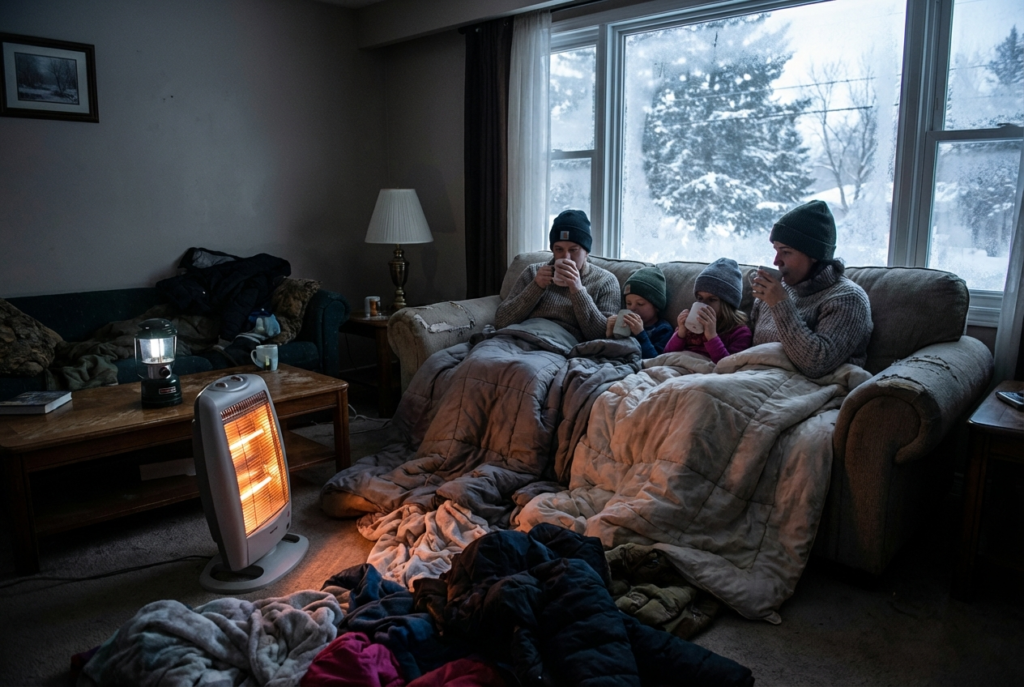
Almost nobody in this part of Missouri is harmed by the cold itself on a night without heat. People are harmed by what they do about the cold. Every rule below exists because of a specific way that goes wrong.
- One heater per circuit. A portable heater on high pulls around fifteen hundred watts, which is twelve and a half amps, against a household circuit rated for fifteen. A bedroom circuit usually feeds more than the bedroom.
- Straight into the wall. Extension cords and power strips are built for lamps and laptops. A heater on a light gauge cord heats the cord instead, inside a coil under a rug where nobody is looking.
- An arm’s length of clear floor. Bedding, curtains, laundry and furniture stay well back from anything glowing.
- Nothing portable runs while people sleep. Heaters off, everyone closed into one or two rooms, blankets doing the overnight work. Electric blankets and heated mattress pads are built for exactly that and are the exception.
- Nothing that burns fuel comes indoors. No grill, no camp stove, no unvented kerosene heater, no generator in an attached garage even with the door up. These make the news every cold snap because carbon monoxide has no smell to warn you.
- The oven door stays shut. A gas range burning in an open kitchen is combustion with nothing venting it, in the room where everyone is standing.
With fragile people in the house and the temperature still falling at midnight, the answer is often somebody else’s warm spare room rather than a better heater. That is the cheapest safe option on the list, not giving up on the night.
What Happens Once the Truck Gets There
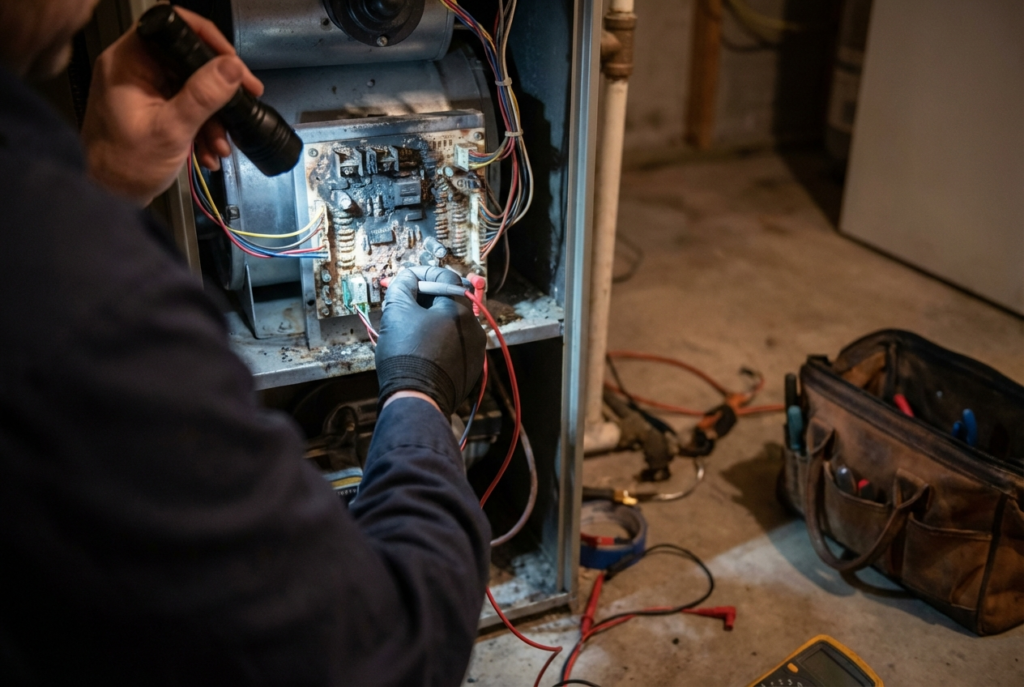
Diagnosis usually moves faster than people expect, because the control board has already written down why it stopped. Behind the panel a small light blinks a fault code, and that code cuts the possibilities to a handful before anyone reaches for a meter.
From there the night goes one of three ways. The part is on the truck, which covers most after hours calls, because ignitors, flame sensors, pressure and limit switches, thermostats and common blower motors all ride with us. The part is not on the truck, and the job becomes getting safe heat into the house until morning. Or the furnace is not going to run again in any honest way, and that is a conversation rather than a repair.
The after hours version of the work is not a shortened version. Combustion still gets measured, the heat exchanger still gets looked at, and nothing gets jumped out to force a furnace to light. A safety defeated at three in the morning is still defeated in March, and by then nobody remembers it is there.
The Parts of This That Truly Have to Wait for Daylight
Some of a cold night cannot be solved at night, and knowing which keeps you from expecting what nobody can deliver. The supply counter is the first. Anything brand specific, anything for a furnace past about twenty years old, and most control boards have to be picked up in daylight hours, and during a hard freeze even the common items thin out.
The gas utility is the second. If your furnace has been shut off and tagged by the gas company, that tag does not come off overnight, and clearing it runs on their calendar rather than ours. Our page on emergency furnace installation covers what that involves.
The last one is a decision rather than a part. Nobody should be picking out a furnace at two in the morning. It is the biggest mechanical purchase most houses ever make, the choice turns on sizing, venting and efficiency, and all three go sideways when a tired person settles them in a cold kitchen. If the furnace is finished, tonight is for temporary heat and the real conversation happens in daylight.
What does not wait is a house that cannot hold out of the fifties with someone fragile in it, or water lines heading for a freeze. Those two are worth the call at any hour of the night.
Frequently Asked Questions
My furnace quit and it is below freezing. Do I need somebody tonight or can it wait until morning?
Read the thermostat twice, half an hour apart. A house drifting down about a degree an hour is uncomfortable but safe until morning. Faster than that, or an infant or elderly person in it, or water lines in a crawl space, and it is worth calling tonight.
Is it safe to reset my own furnace at the breaker?
Yes, once. Cutting power for a minute clears the lockout count and gives the furnace one more attempt. If it locks out again, stop, because repeating it only adds wear to whatever is already failing.
How long will it actually take somebody to get here during a cold snap?
In a hard freeze the order is set by risk rather than by who dialed first, so a house in the forties with a newborn goes ahead of one in the low sixties. If the honest answer is first thing in the morning, we say so while you still have time to plan the night.
The carbon monoxide alarm went off and the furnace was running. What do I do first?
Get everyone out, then call from outside. Do not open windows first, do not hunt for the source, and do not silence it and go back to bed. The fire department takes a reading at no cost, and that reading tells us whether this is a repair or a furnace that never runs again.
Can I run space heaters overnight if I am careful?
No. One per circuit, straight into the wall, nothing near them, and off before anybody sleeps. Overnight warmth belongs to blankets, or to an electric blanket or heated mattress pad, because those are built to run while you are asleep and a portable heater is not.
Am I going to get a sales pitch for a new furnace while I am standing there cold?
No. An after hours call has two possible jobs, restore heat or make the house safe, and neither is a quote. If replacement is coming you will hear it plainly, and the decision waits for daylight.
No Heat Right Now in Oakville
Describe the night, not just the furnace. How cold the house is, which direction it is heading, and who is asleep in it. That is what tells us whether you need a truck tonight or a plan and a morning appointment.
The line is (314) 600-2202, answered around the clock through the heating season. If the house is holding steady and this can keep until business hours, furnace repair sorts the likely causes by what the furnace is doing. If it has pulled this before, furnace maintenance covers the readings that catch these parts before they quit on a January night.