Serving St. Louis & Surrounding Areas

Commercial HVAC Installation in Oakville, MO: Curb, Crane, Changeover
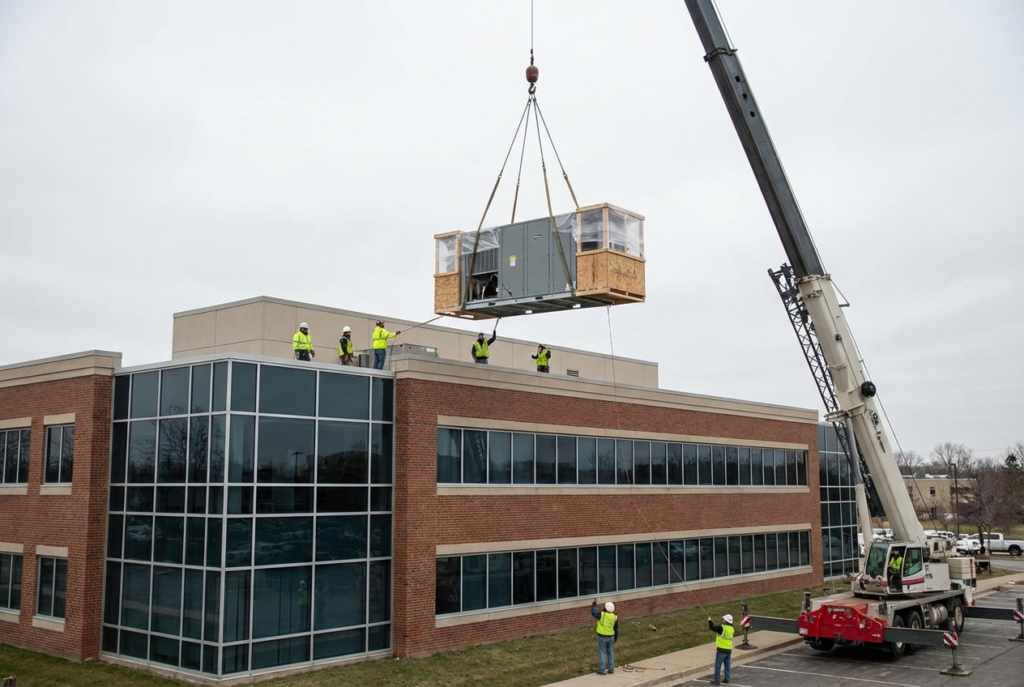
Replacing a rooftop unit is not really an HVAC job with some lifting attached. It is a rigging and roofing project that happens to end with a heating and cooling system, and almost everything that goes wrong with one goes wrong before the equipment is ever energized. So this runs in the order the work actually happens, from the first measurement to the last unit in a phased building.
The Survey, and Why the Curb Governs Everything
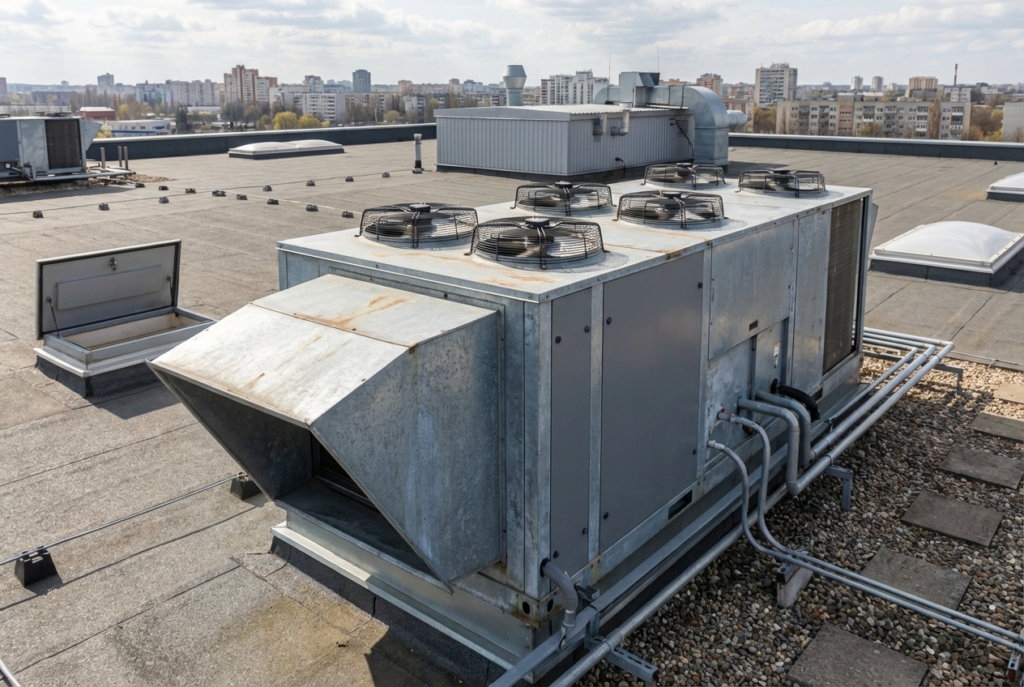
The roof curb is the steel frame the unit sits on. It is built into the roof, flashed into the membrane, and it forms the opening that supply and return air pass through. It is also the single item that decides how the rest of the project goes.
A survey measures the curb footprint and the position of the duct openings inside it, records the existing unit’s weight and electrical characteristics, and assesses the condition of the curb and the roofing around it. Wood nailers rot, flashing fails, and insulation inside a curb gets saturated over the years, none of which is visible until the old unit comes off.
The second half of the survey is structural. A new unit is often a different weight from the one it replaces, and the roof structure has to be confirmed capable of carrying it. On most commercial permits this arrives as a written calculation rather than an opinion, so it belongs at the start of a project rather than in the middle.
This is also when a bad surprise is cheapest. A curb found to be rotten during a survey is a line item. The same curb found on crane day, with a unit hanging from a hook and a hole in your roof, is a very different afternoon.
Curb Adapters Versus Building a New Curb
Replacement units rarely match the old footprint exactly, because manufacturers change cabinet dimensions between generations. That leaves two paths and they are genuinely different projects.
A curb adapter is a fabricated transition that sits between the old curb and the new unit, matching one footprint to the other and realigning the duct openings. It is faster, it avoids opening the roof, and it is usually the right answer when the existing curb is sound. The tradeoffs are that it raises the unit slightly, and a poorly built adapter can throttle airflow at the transition, which is a defect that hides for years as a comfort complaint nobody can trace.
Replacing the curb outright is the answer when the existing one has deteriorated or when the new equipment is dimensionally too far off to adapt cleanly. That means opening the roof, setting a new curb, and reflashing into the membrane, which is roofing work in the middle of a mechanical project.
That raises the question people forget until afterward. If your roof is under warranty, the roofing manufacturer usually specifies who is permitted to modify the membrane and how the work must be documented. Cutting a roof with the wrong crew can void coverage on the entire roof, not merely the patch. Worth confirming during the survey rather than discovering during a claim.
Crane Day, and What It Needs From Your Property
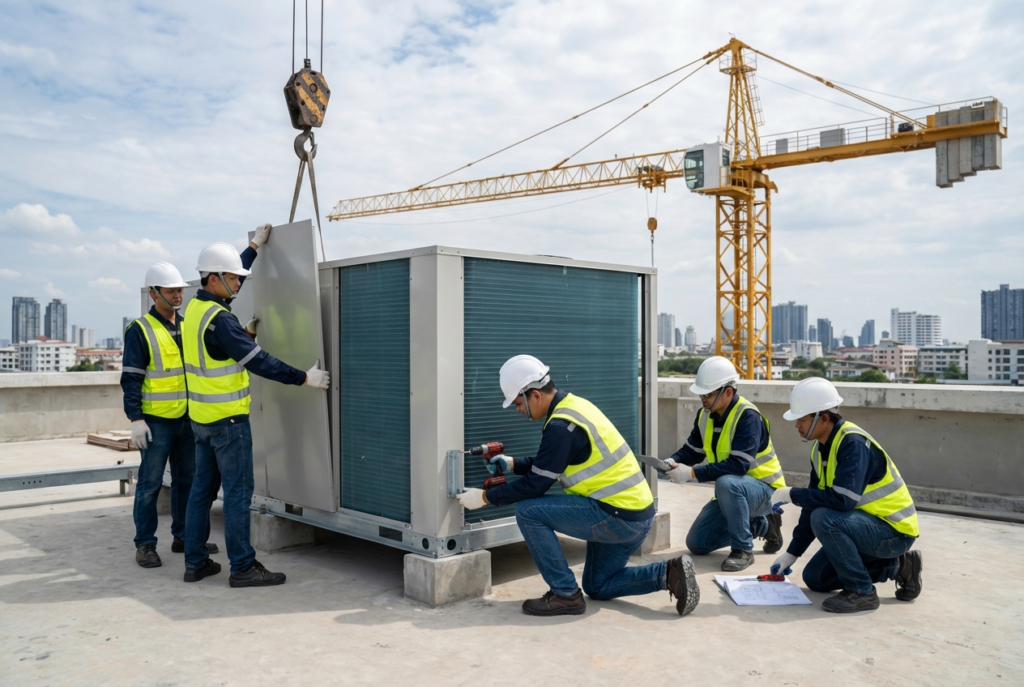
The lift is the shortest and most disruptive part of the whole project, and nearly all of its difficulty is on the ground rather than on the roof.
- A setup pad for the crane. It needs a stable, reasonably level area with room for outriggers, and outriggers concentrate a great deal of weight onto a small footprint. Parking lots handle this fine, though soft asphalt in summer heat and anything built over an underground structure need checking first.
- Parking spaces out of service. Both the crane footprint and the area beneath the swing path have to be clear and stay clear, which usually means coning off a section of lot the evening before.
- A clear path overhead. Power lines, light poles and tree limbs along the swing path decide where the crane can set up, and sometimes decide that a bigger crane at a greater distance is the only option.
- Street or lane permission. If the only workable setup is in the street, that becomes a permit and a lead time rather than a decision made that morning.
- Weather. Wind stops a lift. This is not caution, it is a limit on the equipment, and it is the most common reason a crane day moves.
The lift itself is usually a couple of hours for a single unit. Everything above is what makes those hours possible, and it is why crane day gets scheduled around your building rather than around ours.
The Changeover Window
Between the old unit coming off and the new one running, the area it serves has no conditioning. Planning that window is most of what minimizing disruption actually means.
For a straightforward swap onto a sound curb, that window is usually a single working day. A new curb, significant duct transition work, or electrical changes extend it. The honest version of this conversation happens at the survey, because it is driven by what the roof turns out to need.
Where the calendar allows it, the window goes where the building is empty. A business closed on weekends can lose its conditioning Friday evening and have a commissioned system Monday morning without a single occupied hour affected. Where the building never really closes, the work splits into interior tasks before opening or after closing, with the roof work during the quietest hours available.
If a specific area genuinely cannot go a day without conditioning, say so during planning rather than on the morning of. That constraint changes the sequence, and occasionally it changes which unit gets replaced first.
Connections, Controls, and Commissioning

With the new unit set, the remaining work is what determines whether the building is actually better afterward or merely newer.
Duct transitions get made and sealed at the curb, which is where a badly executed adapter shows itself. Electrical is landed to the disconnect and the unit, and gas piping reconnected and leak checked where the unit is gas fired.
Controls are the part that most often gets short changed. New equipment usually has more capability than the unit it replaced, including economizer operation and occupied and unoccupied scheduling, and if nobody sets those up you have paid for features the building never uses. If your building has an automation system, the new unit has to be integrated with it rather than left running on its own board.
Commissioning is where numbers get taken and written down. Airflow verified to each zone, refrigerant charge confirmed, safeties tested, economizer proven to open and close on command, and schedules programmed to your real operating hours. That record is the baseline everything later gets compared against.
Phasing a Building With Several Units
Many buildings carry three, five or a dozen rooftop units of similar age, which means the replacement question is not whether but in what order.
Replacing everything at once is cheaper per unit, since one crane mobilization covers all of them and the crew is already staged. It is also a single large expense and a bigger disruption compressed into one stretch.
Phasing across seasons spreads the cost and the disruption, and it lets you replace the units serving the most critical areas first while the rest keep running. The cost is repeated mobilization, and the risk is that an unreplaced unit fails on its own schedule in the middle of the plan.
One thing worth deciding early either way is whether to standardize. A building whose units all come from one manufacturer and one generation is far simpler to stock parts for, to service, and to control, and that advantage compounds over the fifteen or twenty years the equipment is on the roof.
Permits, Inspection, and the File You Keep
Commercial mechanical work is permitted and inspected, and the sequence has real effect on the schedule rather than being a formality at the end.
A permit application typically wants the equipment specifications, the electrical work involved, and the structural calculation confirming the roof carries the new load. Approval takes the time it takes, which is why it belongs at the front of the project.
Inspection then confirms the installed work matches what was permitted. Where a roof was opened, keep the roofing documentation with it, because that is what protects your roof warranty later.
Keep the commissioning numbers in the same file as the permit and the roofing paperwork. Three years on, when somebody asks whether a unit has always run this way, that file is the only thing that answers the question.
Frequently Asked Questions
How long will our building be without heating or cooling?
For a straightforward swap onto a sound curb, usually a single working day for the area that unit serves. A new curb, duct transition work or electrical changes extend it. If your building closes on weekends, that window often fits entirely inside the closure so no occupied hours are affected.
What is a roof curb, and why does it matter so much?
It is the steel frame built into the roof that the unit sits on, and it forms the opening the air passes through. It matters because it decides whether your project is a lift and a set, or a lift plus roofing work. Its condition should be assessed during the survey rather than discovered on the day of the lift.
Do you need to close our parking lot?
Part of it, usually from the evening before. The crane needs a stable setup area with room for outriggers, and the ground beneath the swing path has to stay clear throughout. How much space depends on where the crane can reach your roof from, which is decided by overhead obstructions as much as by the building.
Will cutting into the roof void our roof warranty?
It can, which is why it gets confirmed before anything is opened. Roofing manufacturers generally specify who may modify the membrane and how it must be documented, and coverage can be lost on the whole roof rather than just the affected area. If your roof is under warranty, say so at the survey.
Should we replace all our rooftop units at once or one at a time?
All at once costs less per unit because one crane mobilization covers them and the crew is already there. Phasing spreads the expense and the disruption and lets you do the most critical areas first, at the cost of repeated mobilization and the chance an untouched unit fails mid plan. Either way, standardizing on one manufacturer pays off over the equipment’s life.
What can delay a scheduled installation?
Wind is the most common, because it stops a lift outright and is a limit on the crane rather than a judgement call. Permit approval timing and a curb found to be deteriorated are the other two. The first is why permits get filed early, and the second is why the survey matters.
Start With a Roof Survey
The first visit is a measurement rather than a sales call. Curb dimensions and condition, the existing unit’s specifications, roof access, where a crane could physically set up, and whether your roof carries a warranty. Those answers produce a real schedule and a real number instead of an estimate that moves later.
Call (314) 600-2202 to arrange one. If the equipment is still serviceable and you are deciding whether replacement is premature, commercial HVAC repair is the other side of that question. New equipment is also the moment an agreement is worth reading properly, and commercial HVAC maintenance walks through one clause by clause.