Serving St. Louis & Surrounding Areas

Commercial HVAC Maintenance in Oakville, MO: Read the Agreement
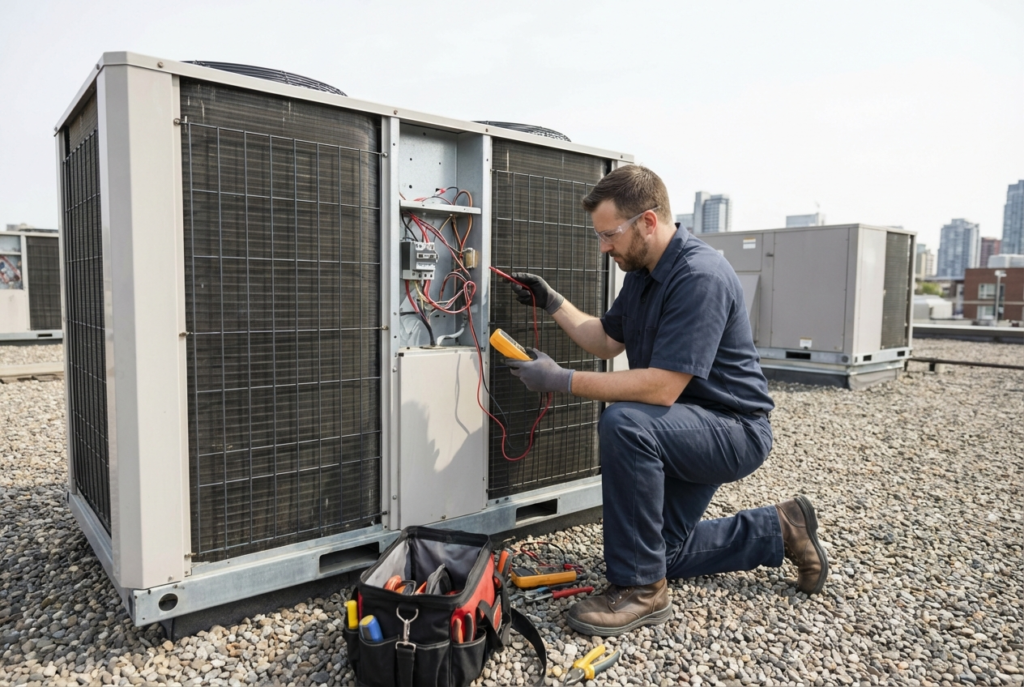
Plenty of building owners are paying for a maintenance agreement they have never actually read, and could not say what it obligates anybody to do. That is not carelessness. These documents are written to be signed rather than read. So rather than explaining why maintenance matters, this page goes through an agreement clause by clause, so you can hold yours up against it. Including ours.
What the Word Covered Is Doing in Your Agreement
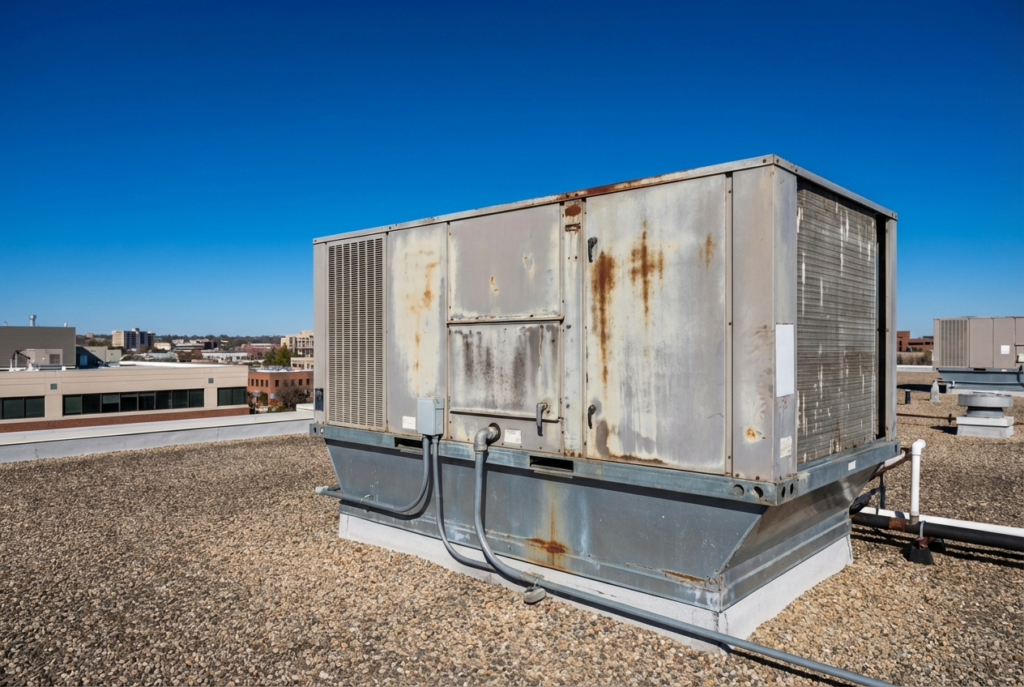
This is the clause that causes the most unpleasant surprises, because the word covered means three completely different things depending on the contract.
- Inspection only. The visit is included. Anything found is quoted and billed as a repair. Most agreements sold as maintenance are this, and there is nothing wrong with it as long as you know that is what you bought.
- Inspection plus labor. The visit and the labor to fix what is found are included, and you pay for parts. The distinction matters most on rooftop work, where reaching the equipment is a meaningful share of the hours.
- Full coverage. Parts and labor both included, usually with a list of exclusions that is the part worth reading. Compressors and heat exchangers are commonly excluded, and those are the failures you were most worried about.
Find the sentence in your agreement that answers this, and if you cannot find it, that is itself the answer.
Visit Frequency, and When They Are Scheduled
Two visits a year is the standard for commercial equipment, and the number matters less than the timing. The visits belong in the shoulder seasons, before cooling season and before heating season, because the point is to find a failing part while there is still time to order it and while a technician is still available.
An agreement that promises two visits without specifying when they happen can satisfy itself in July and January, which is when the finding is least useful and the parts are hardest to get.
Some buildings genuinely need more. A commercial kitchen puts grease into the airstream and loads filters far faster than an office does. High traffic retail runs its equipment harder. Any space where a temperature requirement protects product has a different risk profile entirely. If your building is one of these, the frequency clause should say so rather than defaulting to twice a year because that is what the form said.
Included Versus Billed Separately
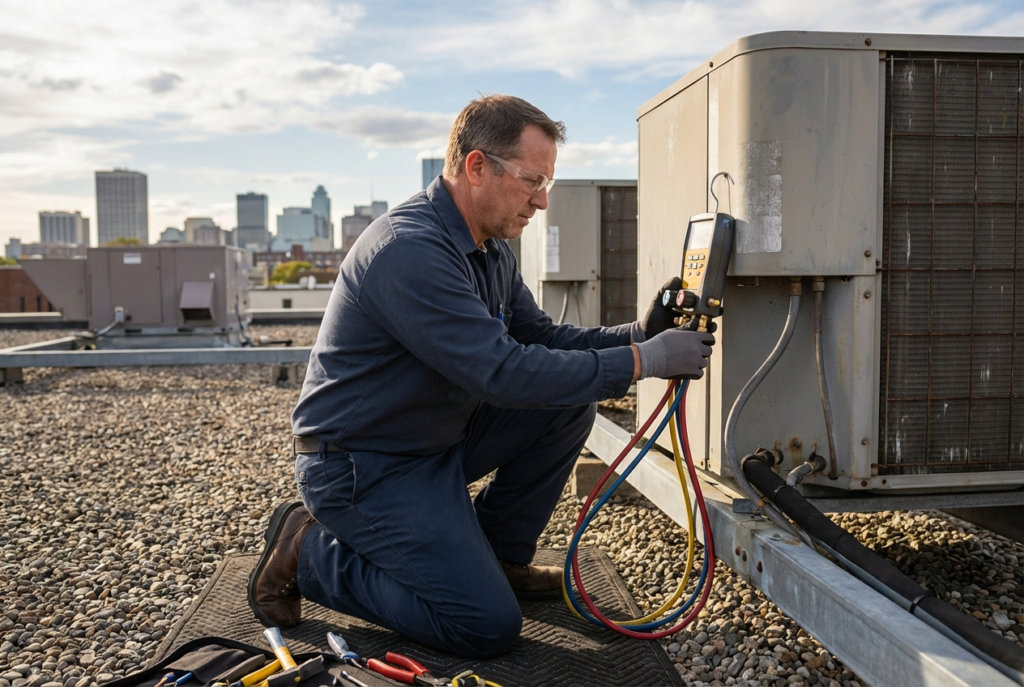
This is where the invoice that surprises you comes from, and it is almost always one of the same handful of items.
- Filters. Frequently billed as materials even when the labor to change them is included. Worth knowing given how many a commercial unit takes.
- Belts. Often listed as an inspection item and charged when replaced, which is reasonable, but it should be stated.
- Refrigerant. Almost never included in any tier. If a system is low, adding refrigerant is billable and, more to the point, means there is a leak that needs finding rather than topping up.
- Coil cleaning. Sometimes a scheduled task, sometimes a separate service. A deep clean is a different job from a rinse and the agreement should distinguish them.
- After hours labor. Even under full coverage, work outside business hours usually carries a different rate. That clause is worth reading before you need it rather than after.
What the Response Clause Actually Commits To
Priority scheduling is the phrase most agreements use, and on its own it commits nobody to anything. A real response clause answers three questions.
How long is the window, and in what units. Four hours and one business day are very different promises, and business hours quietly excludes evenings, weekends and holidays, which is when buildings tend to fail.
When does the clock start. At your call, or at dispatch, or when a technician leaves another job. These produce very different real world outcomes from the same printed number.
What happens if the window is missed. Most agreements say nothing at all, which is worth knowing, because it tells you the number is a goal rather than a term.
Ours is straightforward. Agreement customers go ahead of non agreement calls, and we would rather tell you a real arrival time on the phone than print an impressive one in a contract.
The Paperwork You Should Get Afterward

The documentation clause looks like the least interesting part of the agreement and it is the one most likely to matter financially.
Manufacturer warranties on commercial equipment generally require documented maintenance. When a compressor fails inside its warranty period, the claim can turn on whether you can produce records showing the unit was serviced. A file of dated reports with actual readings is what makes that claim straightforward. An agreement that produces no paperwork leaves you arguing from memory.
Useful documentation names the unit, the date, what was measured, what was found, and what was recommended but not done. That last item is the one people skip, and it is what turns a stack of reports into a record of a system trending in some direction rather than a series of unrelated visits.
If your building has any compliance obligation tied to temperature or air handling, this file is also where that evidence lives.
Term, Renewal, and What Happens If You Sell
The administrative clauses at the end are short and worth thirty seconds each.
- Term and auto renewal. Most agreements renew automatically. Find the notice period, because it is often narrower than people assume.
- Price escalation. Some contracts allow a yearly increase by a stated amount or by an index. Fine if it is disclosed, unwelcome if discovered.
- Equipment covered. Listed by unit, not by building. Adding a rooftop unit later does not automatically bring it under the agreement.
- Transferability. If the building changes hands, or you move, whether the agreement follows is worth knowing in advance.
Reading a Scope Before You Sign It, Including Ours
A legitimate scope of work is specific enough to be checked afterward. Vague language such as full inspection is not a scope, it is a description of one.
The practical test is whether you could stand next to the technician and confirm each line happened. Electrical connections tightened, refrigerant pressures read and recorded, coils cleaned, belt tension set, condensate line cleared, controls and safeties verified. Named tasks with results you receive in writing.
Liberty has been working on commercial and residential systems in Oakville for twenty seven years, and a fair number of the buildings on our maintenance list have been with us for more than a decade. That continuity is worth asking any contractor about, because a technician who has been to your roof before knows what your equipment looked like last time, and noticing a change is most of what maintenance actually is.
Our agreements run on twice yearly visits, a written scope, documented findings after every visit, and priority scheduling if something comes up in between. You know what is included and what it costs before anybody starts.
Frequently Asked Questions
Does my maintenance agreement cover repairs, or just the inspection?
It depends entirely on which tier you signed. Most agreements sold as maintenance are inspection only, meaning the visit is included and anything found is quoted separately. Others include labor but not parts, and full coverage agreements usually carry an exclusion list. Find that clause in your document, because assuming is where the unpleasant invoice comes from.
How often should commercial equipment be serviced?
Twice a year for most buildings, and the timing matters as much as the count. The visits belong before cooling season and before heating season so a failing part is found while there is still time to order it. Commercial kitchens, high traffic retail and any space with a temperature requirement often need more.
Is refrigerant included in a maintenance agreement?
Almost never, at any tier. It is also worth treating a low charge as information rather than a supply issue. A sealed system does not consume refrigerant, so being low means there is a leak, and repeatedly topping it up pays for the same problem every year.
What does priority scheduling actually guarantee?
On its own, very little, which is why the clause is worth reading closely. Ask how long the window is, whether it is measured in hours or business days, when the clock starts, and what happens if it is missed. Most agreements are silent on that last point.
Why does documentation matter if the equipment is running fine?
Because manufacturer warranties on commercial equipment generally require documented maintenance. When a major component fails inside its warranty period, the claim can turn on whether you can produce dated service records. That file is also where you see a system trending in a direction rather than a series of unrelated visits.
The technician was in and out in half an hour. Should I be concerned?
Possibly, though the clock is the wrong instrument. Compare the written report against the written scope instead. A rooftop unit serviced to a real scope produces recorded readings for each task, so if items in your scope have no corresponding numbers in the report, that is the specific question to ask, rather than arguing about how long somebody stayed.
Have Your Current Agreement Looked At
If you already have an agreement with somebody else, bring it. Reading it against the clauses above takes a few minutes and tells you what you are actually buying, which is useful information whether or not you change anything.
Reach us at (314) 600-2202 to talk through commercial maintenance. If something is broken right now, that is a different conversation and commercial HVAC repair covers it by building type. If the equipment is far enough along that agreements are beside the point, commercial HVAC installation covers replacing it without closing.