Serving St. Louis & Surrounding Areas
Commercial HVAC Repair in Oakville, MO: Sorted by Your Building
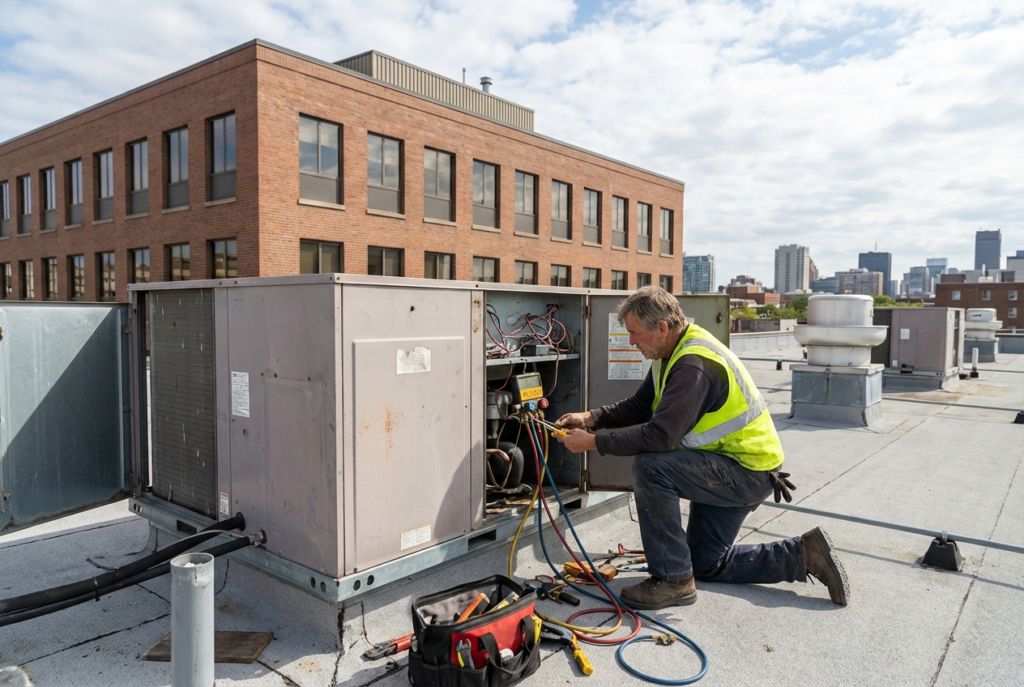
A rooftop unit fails the same way over a diner as it does over an accounting office. The compressor does not know what is underneath it. What changes completely is what that failure costs, how many hours you have before it turns into lost money, and therefore what should be fixed first. So this page is organized by what kind of building you run.
Restaurants and Commercial Kitchens
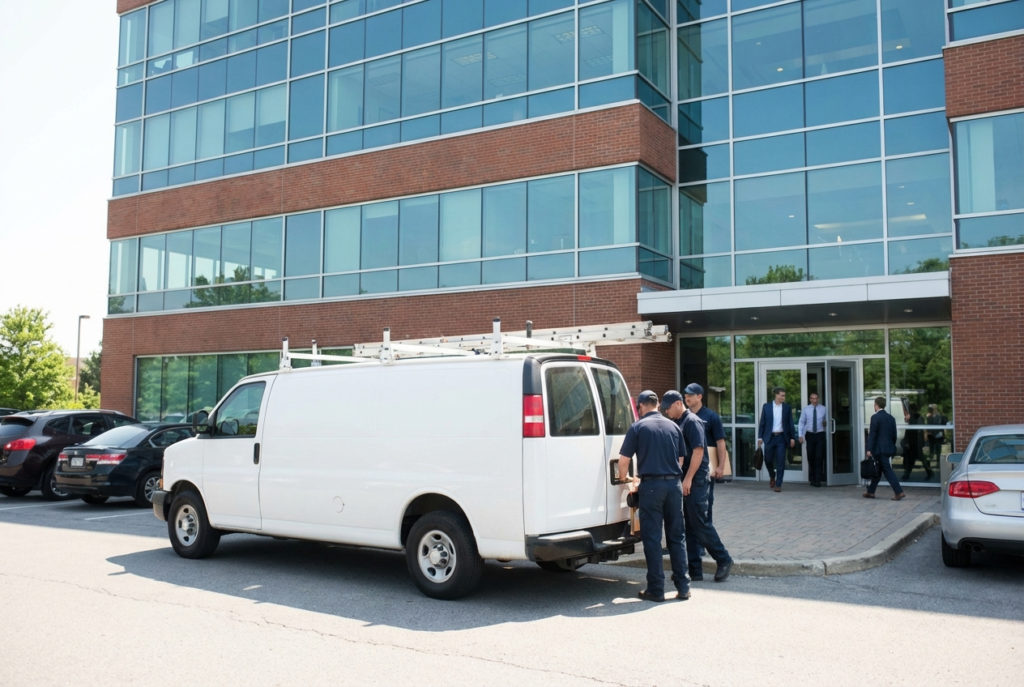
Restaurants are the least forgiving buildings we work in, because the kitchen exhaust makes the whole building a pressure balance problem rather than a comfort problem.
Hood exhaust pulls an enormous volume of air out of the building, and a makeup air unit is supposed to put a matching volume back. When that makeup air unit fails, the exhaust keeps pulling and nothing replaces it, so the building goes negative. The symptoms rarely look like an HVAC problem at first. Entry doors become hard to pull open. The hood stops capturing properly and smoke rolls out into the kitchen. Pilot lights and burners behave strangely. In winter, cold air comes howling in through every gap the building has.
The dining room is the other half. A dining room that was comfortable at eleven and unbearable at seven is usually a capacity problem meeting a full room, not a broken unit, and the fix may be balance and scheduling rather than parts.
Timing here is unlike anywhere else. There is a genuine window between lunch and dinner service, and work that happens inside it costs a restaurant nothing. The same work at six in the evening can close the dining room.
Offices and Multi Tenant Buildings
Offices are where the complaint and the fault are furthest apart, because these buildings are divided into zones and the zone is usually what has failed.
The classic report is that one side of a floor is freezing while the other side bakes, with the equipment on the roof running perfectly. That points at zone dampers, at a VAV box that has stopped modulating, or at a thermostat reading a spot that is not representative of the space, such as a sensor in direct sun or one mounted above a copier.
Scheduling is the second common fault and the cheapest to fix. Commercial controls run on occupied and unoccupied schedules, and when those drift, or nobody updated them after the hours changed, you get a building that is cold when people arrive and conditioned hard all weekend while it is empty. That shows up on the utility bill long before anybody files a comfort complaint.
In multi tenant buildings the practical question is often which equipment belongs to whom. Sorting out the split between landlord and tenant before work starts avoids the billing argument that otherwise arrives with the invoice.
Retail Storefronts
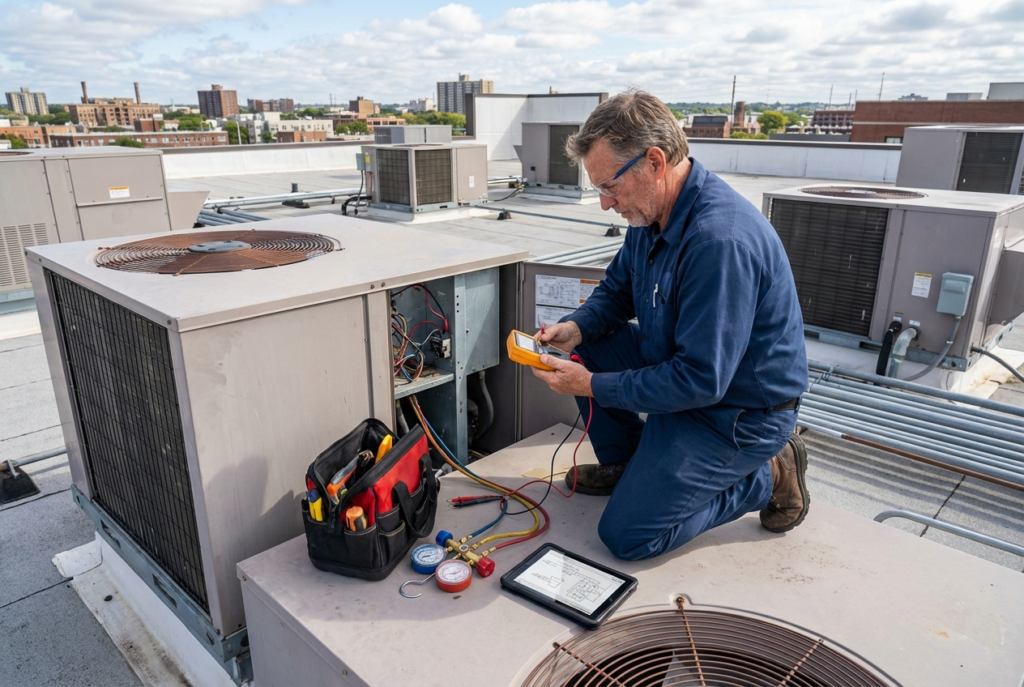
Retail lives or dies at the front door, and the front door is a hole in the building envelope that opens and closes all day long.
Entry areas are the hardest space in a store to hold, because every customer brings outdoor air in with them and glass frontage adds a solar load that peaks in the afternoon. A store that holds temperature all morning and loses it after two is usually describing sun and traffic rather than a failing compressor.
The stockroom is the reverse problem and it matters more than people expect. It is often served by the same unit as the sales floor with no separate control, so getting the floor comfortable means over conditioning a room full of boxes, or leaving the stockroom bearable and the floor wrong.
What a failure costs here is dwell time. Customers do not usually announce that they left because a store was uncomfortable, which makes this the segment where losses are hardest to see and easiest to underestimate.
Warehouses, Shops, and Light Industrial
Big volume buildings behave differently enough that residential intuition is actively misleading here.
Most of these spaces are heated by unit heaters or radiant tube rather than by ducted air, and heat stratifies hard under a high roof. A gap of twenty degrees or more between the roof line and the floor where people actually work is common in an unmixed space. When someone reports being cold in a building whose thermostat says it is warm, stratification is the first thing to check, and destratification fans often solve more than added heating capacity would.
Radiant tube heaters fail in their own particular ways, generally at the ignition and controls end or in the vent path, and they warm objects and people rather than air, which is why a space can feel comfortable at a lower air temperature than the thermostat suggests.
Cooling is usually partial by design. Spot cooling over workstations, or a conditioned office box built inside the larger shell, is the normal arrangement. If any part of the building stores product with a temperature requirement, say so early, because that changes what has to be protected first.
What Is Actually Failing Up There

Underneath the segments, rooftop equipment fails in a fairly predictable set of ways, largely because it lives outdoors year round and runs long hours.
- Contactors and capacitors. Among the most common commercial repairs there are. Contactors make and break under load thousands of times a season and eventually pit, weld or chatter.
- Belt driven blowers. Many commercial units still use belts, which stretch, glaze and squeal. Tension is a maintenance item that becomes a repair when it is skipped.
- Economizer dampers. When an economizer sticks open in January or closed in May, the unit either fights outdoor air or refuses free cooling. These fail quietly and get discovered on the utility bill.
- Refrigerant leaks at vibration points. Rooftop line sets flex in wind and expand with temperature, and joints work loose where they are not supported.
- Curb and cabinet leaks. Water entering where the unit meets the roof curb reaches electrical components and shows up as intermittent faults long before anybody suspects a roof problem.
The intermittent ones are worth flagging when you call. A unit that fails on hot afternoons and works fine when a technician arrives at nine is telling you something specific, and it changes when somebody should come out.
Getting It Fixed Without Closing
Almost all commercial repair happens while the business is open, which makes sequencing part of the job rather than a courtesy.
Roof access usually needs arranging in advance, particularly in multi tenant buildings where a landlord holds the key or the hatch and where insurance requires notice. Sorting that on the first call saves a wasted visit.
When a part has to be sourced and the building cannot go without conditioning, portable equipment can cover the areas that matter most. It is rented rather than free and it will not condition an entire building, but it keeps a dining room or a sales floor usable while the real repair waits on a component.
The most useful thing you can tell us is which hours genuinely cannot be touched. Every business has them, they are different in every building, and they are the one thing we cannot work out from the outside.
Frequently Asked Questions
One side of our office is freezing and the other side is too warm. Is the rooftop unit bad?
Usually not. That pattern points at zoning rather than at the equipment, meaning a zone damper that is stuck, a VAV box that has stopped modulating, or a thermostat reading an unrepresentative spot such as one in direct sun. The unit itself is often working exactly as intended.
The doors in our restaurant are hard to open and the hood is not pulling smoke. Is that HVAC?
Yes, and it is worth treating as urgent. Those are the signatures of a building running negative because the kitchen exhaust is removing more air than the makeup air unit is replacing. It affects hood capture and combustion appliances, so it is a safety issue as much as a comfort one.
Our warehouse thermostat reads seventy but the floor is cold. What is going on?
Heat stratification. In a high bay building warm air collects at the roof while the occupied level stays cold, and a thermostat mounted high reads the warm layer. Destratification fans that push that air back down often resolve it for far less than adding heating capacity would.
Can you work on our system without shutting the business down?
Nearly always. Most commercial repair happens around an operating business, which mostly means scheduling the disruptive portion outside your critical hours and arranging roof access in advance. Tell us which hours cannot be touched, because that is the part we cannot figure out on our own.
How fast can somebody get here during business hours?
Commercial calls placed during the working day are typically handled the same day. The honest variable is parts. Contactors, capacitors, belts and common motors ride on the truck, while compressors and unit specific components may need sourcing, and you will get a real timeline rather than an optimistic one.
Our unit only fails on hot afternoons and works fine when the technician arrives. What now?
Say exactly that when you call, because it is diagnostic rather than frustrating. Intermittent faults that track with heat load point toward specific causes such as electrical components failing at temperature or a refrigerant charge issue, and it changes what time of day somebody should be standing on your roof.
Commercial Service in Oakville
Start by telling us what kind of building it is and which hours are untouchable. Those two facts shape the visit more than the model number on the roof does.
Our number is (314) 600-2202. If the building is down right now and every hour is costing you, emergency commercial HVAC covers how those calls get ordered and what changes the answer. If your equipment keeps producing the same failure, commercial HVAC maintenance covers what a service agreement actually includes.